
Twice a year suits most Melbourne homes: once after the main autumn drop, once before the storms of late spring, and three or four times under eucalypts. But the reliable test is the downpipe rather than the calendar — if water spills over the front edge in heavy rain, you are already overdue whatever the month. This guide covers how to clean gutters without making things worse, when the job is yours and when it is not, and why box gutters break every rule in it. Where it stops being a ladder job, that is [gutter cleaning](/gutter-cleaning).
How often to clean gutters, decided by the canopy
The variable is not your suburb and not the age of the house. It is what hangs over the roof and how far the branches reach.
Our working schedule, from the jobs we actually do: a roof with no canopy over it goes once a year. A roof with deciduous trees nearby goes twice — after the drop and before the storms. A roof under eucalypts goes three or four times, because the shedding never really stops.
Gutter guards change the interval but not the need. They keep leaves out and let the fine material through, so the gutter fills slower and the downpipe throat still blocks. A guarded gutter that has never been opened in five years is usually worse than an unguarded one cleaned every autumn.
Two things push any of those numbers up. A shallow-fall gutter that was installed near level, and a roof that collects from a large area into one downpipe. Both mean less tolerance for the same amount of debris.
Why the autumn rule is imported advice
Clean your gutters in autumn is advice written for places where trees are bare by June and everything that was going to fall has fallen.
Eucalypts do not work that way. They shed leaf through summer, drop bark in long strips through the warm months, and let go of gum nuts and small branches whenever it blows. There is no month when a gum roof is finished dropping.
That matters more than it sounds. Under a deciduous tree, one clean at the right moment gets almost everything. Under a gum, the same clean gets whatever happened to be there that week.
So the schedule follows the tree, not the season. If you are not sure what is over your roof, the debris in the gutter tells you: broad flat leaves and seed stems mean deciduous, and narrow hard leaves with bark ribbons and nuts mean eucalypt.
One more local wrinkle. Melbourne gets rain spread through the year rather than concentrated in a wet season, so a blocked gutter here does not wait for a monsoon to cause damage. It gets tested most months.
Signs the gutter is already full
The first one is the only one that needs no interpretation. Stand outside during heavy rain and watch the gutter line. Water should leave through the downpipe. If it is coming over the front edge in a sheet, the gutter is full, and no calendar argument beats that.
Plants growing in the gutter mean a seed germinated in packed organic matter and had a season to do it. That is not a warning sign, it is a diagnosis.
Streaks or mineral marks on the fascia below the gutter line show overflow that has been happening long enough to leave a record. On a rendered or painted wall the same overflow shows as a dark vertical band.
A gutter that sags between brackets is carrying weight it was not designed for — wet debris is heavy, and once the brackets pull, the fall goes wrong and the section holds water permanently.
A downpipe that gurgles, runs slowly, or stays dry while the gutter is clearly full has a blockage at the outlet rather than along the run. That is the failure people miss, because from the ground the gutter looks clear.
Birds nesting in the gutter line are worth noticing for the same reason as the plants. They build where there is already a base to build on.
Skip the checklist
Get a fixed-price quote for your suburb
10 minutes. Insured local techs. Before-and-after photos every job.
How to clean gutters without making it worse
How to clean house gutters is the same job on a weatherboard cottage and on a rendered two-storey — the order matters more than the tools, and most of the damage people do is done in the wrong order.
Scoop first, water second. Reach in and lift the material out into a bucket or a bag. Hosing a full gutter simply moves the debris along the run and packs it into the downpipe throat, which turns a twenty-minute job into a plumbing problem.
Work away from the downpipe, not toward it. Start at the outlet end and move along, so what you disturb is never being pushed at the hole.
Once the gutter is empty, flush it and watch the outlet. The point of the flush is not to rinse the gutter — it is to confirm the downpipe actually runs. A clean gutter over a blocked downpipe is a gutter that will overflow at the first serious rain.
Knowing how to clean roof gutters includes knowing what to do with what comes out. Take the debris away rather than dropping it. Wet leaf litter tipped onto a garden bed under the eaves is back in the gutter within a season, and on a paved area it stains.
The best way to clean gutters, in short, is to empty them by hand, flush them afterwards, and prove the outlet before you come down the ladder.
Cleaning gutters from the ground
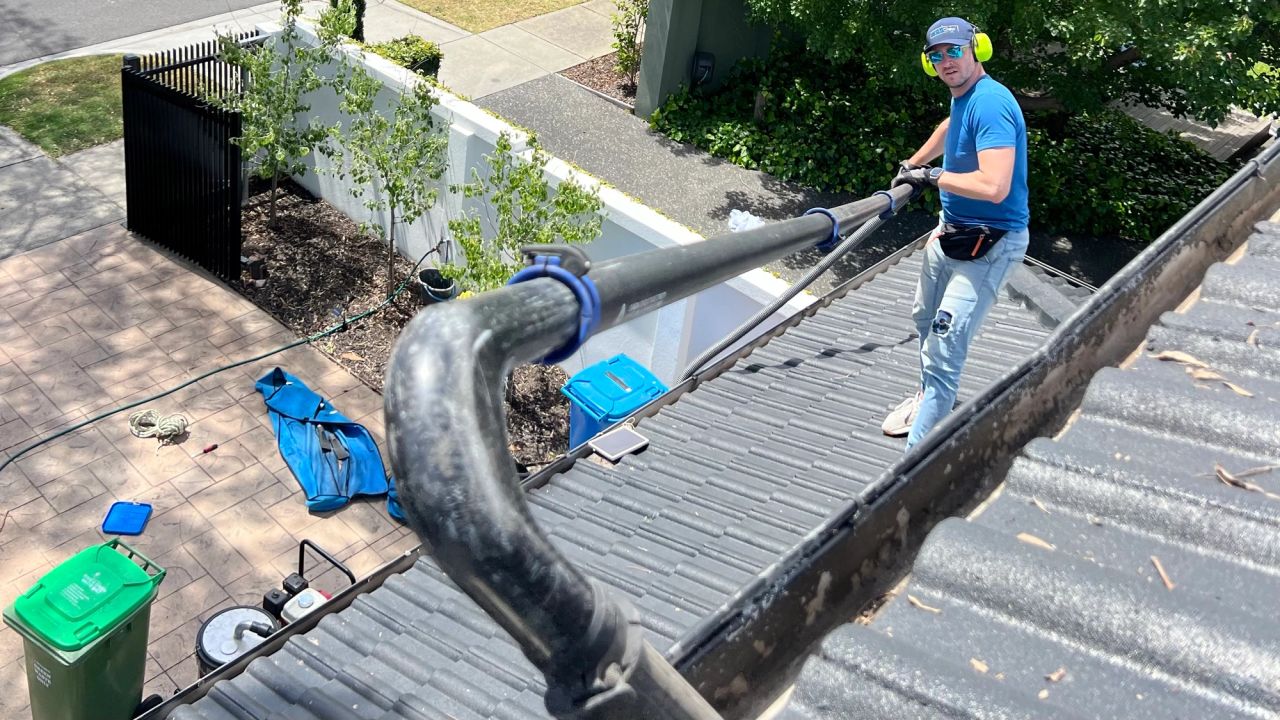
Cleaning gutters from the ground is possible and it is the safest version of the job for anyone who does not want to be on a ladder. A vacuum on carbon poles reaches the gutter line from below, and a camera on the end shows what is happening up there.
It works well on a standard eaves gutter with dry or lightly damp debris, and it is the whole reason a second storey can be done without anyone leaving the ground.
It works badly on material that has been wet and compacted for years, which behaves more like soil than like leaves. It cannot clear a blocked downpipe from above, and it cannot do much with a box gutter, where the geometry defeats the pole.
So a ground vacuum is a method, not a guarantee. Anyone who says it handles every roof has not met a gutter with three seasons of gum bark composted into it.
What does not work, and what only looks like it
Gutter guard sold as never clean your gutters again. Mesh keeps leaves out and lets the fine material through, so the gutter fills with grit and broken-down organic matter instead of leaves. It fills slower, which is worth paying for. It does not stop filling, and the outlet underneath still blocks.
A leaf blower used along the gutter from up on the roof. It moves the debris rather than removing it, and most of it ends up either over the edge into the garden or packed against the downpipe outlet. It also puts you on a roof, which is the thing worth avoiding.
Hosing upward into the gutter from the ground. It looks productive and it is the fastest way to turn loose leaf litter into a plug at the outlet, because the water pushes everything toward the one hole and then leaves it there.
Anything sold as a chemical treatment for gutters. There is nothing in a gutter to treat. It is not a growth problem, it is a volume problem, and the only fix is taking the volume out.
Box gutters break every rule above
A box gutter is not a gutter hung on the edge of a roof. It runs between two roof planes, or behind a parapet wall, and both of its long sides are walls rather than a lip.
That single difference changes what failure looks like. An ordinary eaves gutter that blocks overflows over its front edge and the water lands outside on the ground, which is untidy and harmless. A box gutter that blocks has nowhere outside to go, so the water rises until it finds the roof structure, and it goes into the building.
Which is why the first sign of a blocked box gutter is usually a stain on a ceiling, not a drip in the garden. By then the water has been inside for a while.
Box gutters are supposed to have their own overflow, sized and positioned to dump the water clear of the building when the outlet blocks. That overflow needs checking too — an overflow that is itself packed with leaf litter is decoration.
You find them on Victorian terraces, on rear extensions where a new roof meets an old one, on anything with a parapet, and on most apartment blocks. If your roof has one, the schedule above does not apply to it. It gets looked at more often, and it does not wait for a convenient month.
What gutters have to do with fire season
This section does not apply to every Melbourne address, and it would be dishonest to pretend otherwise. Inner suburbs are not bushfire country. The outer fringe, the hills and anywhere backing onto reserve are a different conversation.
For those addresses, the CFA is blunt about the mechanism in its material on ember attack: “Embers can land on top of debris in your gutters and set fire to your house.”
It also puts that risk above the one most people picture. “Ember attack is the most common way houses catch fire during bushfires,” and it “can happen before, during and after a bushfire.” The flame front does not have to reach you.
Clearing gutters sits on the CFA's own list of property preparation steps, alongside pruning branches off the roof and keeping grass under ten centimetres.
The timing point is the practical one. A gutter cleared in February is not much use — the preparation belongs before the season, not during it, and every contractor in the state is booked out once the first warnings go out.
The part of this job that actually hurts people
Gutter cleaning is not a dangerous job. Ladders are a dangerous object, and gutter cleaning is one of the main reasons people get on one.
The Australian Institute of Health and Welfare counted hospitalised falls involving ladders among people aged 65 and over. In 2019–20 the age-standardised rate was 95.8 cases per 100,000 for men and 26.4 for women.
That gap is not physiology. It is who climbs the ladder to do the outside jobs, and it is worth sitting with for a second if you are the person in your household who always does.
None of that means nobody should use a ladder. It means the ladder deserves the same seriousness as the roof: level footing, someone else at home, both hands free, and the discipline to move it rather than lean off it.
When it is a ladder job, and when it is not
Single storey, a gutter you can reach from a ladder standing on level ground, someone else at home, and a roof you are not planning to walk on. That is a Saturday morning, and paying somebody for it is optional.
It stops being that at the second storey, on a steep pitch, on terracotta you cannot walk without cracking, when the ladder has nowhere flat to stand, or when the roof has box gutters. Any one of those is enough.
For the record, the numbers are on the service page rather than here: a single-storey house starts at $275 and a double storey at $418, including GST. If the roof needs washing at the same time, doing both in one visit costs less than two separate ones.
Whichever way you go, ask for photographs of the gutter after the clean and of the downpipe running. It is the only part of this job you cannot check from the ground, and it is the part most often skipped.
That is what gutter cleaning covers. The rest of this page is yours to act on without calling anybody.
Want this done properly?
Free quote by suburb. If we service your area we'll usually have you booked within 5 working days.