Solar Panel Cleaning Melbourne
Panels lose output long before the glass looks dirty. Demineralised water, no abrasives, the array isolated before anything gets wet, photos before and after on the day.
- $20M public liability insurance
- Police-checked, WorkSafe compliant
- 5.0 from 170 Google reviews
- Not happy with the work? You don't pay
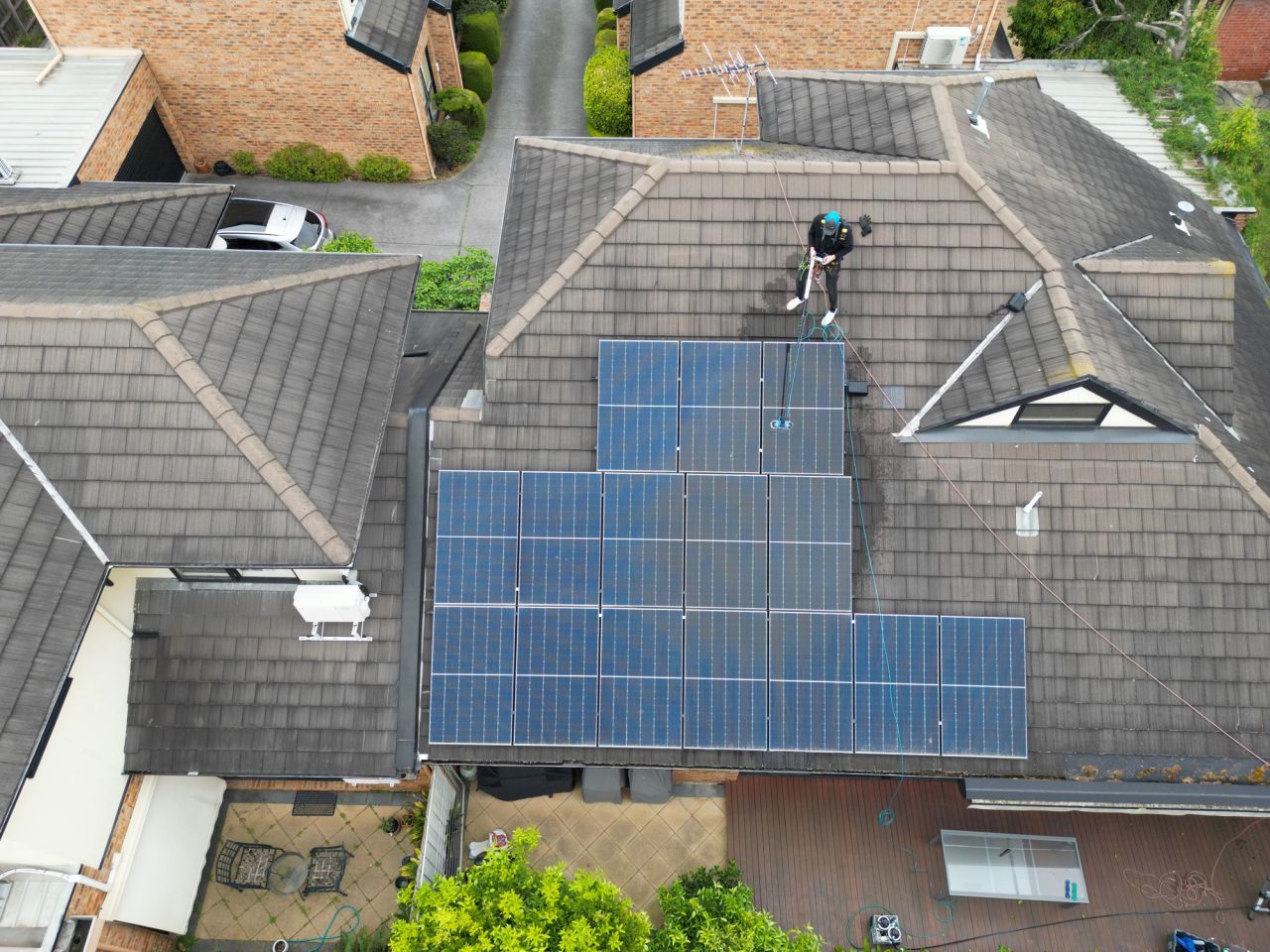
Solar panels only pay for themselves while they're clean. Dust, pollen and bird mess build up on the glass, and every bit of it sits between the sun and the cell underneath.
We clean panels with demineralised water and no abrasives, on houses, commercial roofs and farm arrays across Melbourne. Photos before and after, on the day.
From $4 a panel on commercial roofs of fifty panels or more, $8 a panel on a single-storey house and $12 on a double-storey. Minimum call-out $220 including GST, and every price on this page includes GST.
Fixed price per panel, insured crew, and a report you can file. Solar panel cleaning services across Melbourne, from a single home array to a commercial roof.
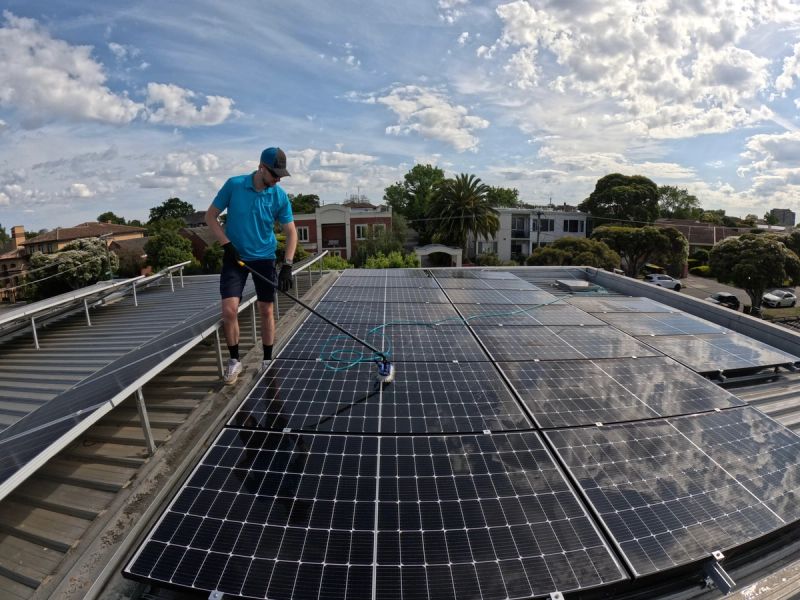
Two ways to book solar panel cleaning services
Most people book solar panel cleaning services one of two ways, and it's worth knowing which suits you before you call.
- The first is a one-off. Something has changed — output dropped, the roofers left dust everywhere, a season of blossom went over the array — and you want it dealt with once. We quote from the panel count and the roof, come out, clean, and send the photos. No plan, no commitment, no follow-up unless you ask for one.
- The second is a standing job. The array gets cleaned on a set interval and you stop thinking about it. This is what commercial roofs and larger home systems usually end up on, because nobody notices a slow decline in output until the bill arrives, and by then it's been building for a year.
- Neither is better. A shaded suburban array under a gum tree needs a different rhythm to a warehouse roof out in the open, and the honest answer is that we can tell you which after we've seen it once.
- What we won't do is put you on a schedule you don't need. If the array is on an open roof with nothing overhanging it, once every couple of years may be all it asks for, and we'd rather say that than sell a plan.
What lands on panels and what each thing does
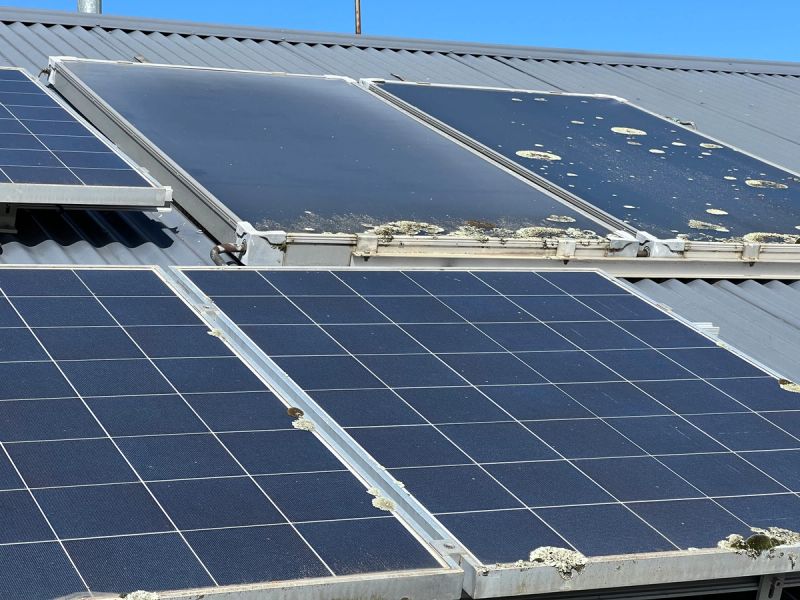
Three things end up on a panel, and they behave differently enough that they're worth separating.
Dust and pollen. The film nobody sees. It arrives evenly, it builds slowly, and because it covers the whole surface at once there's no obvious dirty patch to notice. On a low-pitch array it stays put: there isn't enough slope for rain to carry it off, so each shower leaves a little more behind than it takes away.
Bird droppings. The opposite problem — small, obvious and completely opaque. Light doesn't get through them at all, so the cells underneath stop contributing while the rest of the array carries on. They also bake on. Fresh mess rinses; the same spot after a fortnight of sun has to be softened before anything will move it.
Moss and lichen along the frame. This is the one that does lasting damage. Growth takes hold where the frame meets the glass, holds water against the seal instead of letting it run off, and creeps inward from the edge. Left long enough it stops being a cleaning question and becomes a replacement one.
There's a fourth thing on some roofs, and it isn't dirt at all. Panels sitting under a gum drop into shade for part of the day, and no amount of cleaning fixes shading. If that's what's happening we'll tell you, because a clean won't change the number on your bill.
| What goes wrong | What causes it | What it costs | How to prevent it |
|---|---|---|---|
| Output below what the array can make | A film of dust and pollen across the whole surface | Lower generation every day the film stays on the glassNo published figureTrade experience, no published figure | Clean on a set interval instead of waiting for the bill to show it |
| Cells covered and contributing nothing | Bird droppings baked on, which rain doesn't shift | The covered cells stop working while the rest carries onNo published figureTrade experience, no published figure | Remove them while they're fresh — baked-on mess needs soaking |
| Seal breaking down at the frame | Moss and lichen holding water against the frame edge | Replacement of the panel once moisture gets past the sealNo published figureTrade experience, no published figure | Clean the frames and edges, not just the glass |
| Anti-reflective coating scratched | Abrasive pads, brushes or grit dragged across dry glass | Permanent. A scratched panel can't be restored, only replacedNo published figureTrade experience, no published figure | Demineralised water, soft heads, nothing abrasive |
| Water forced past the seal | High-pressure washing aimed at the panel | Internal moisture, then failure of the affected panelNo published figureTrade experience, no published figure | Never pressure wash a panel, at any setting |
| Warranty cover refused | A cleaning method outside what the manufacturer allows | The replacement is carried by the owner rather than the makerNo published figureManufacturer warranty terms — check the documents for your panels | Keep the method conservative and keep dated photo records |
Sources
No published dollar figure exists for the effect of soiling on a Melbourne rooftop array, so none is quoted here. The warranty row points to the manufacturer's own documents for your panels.
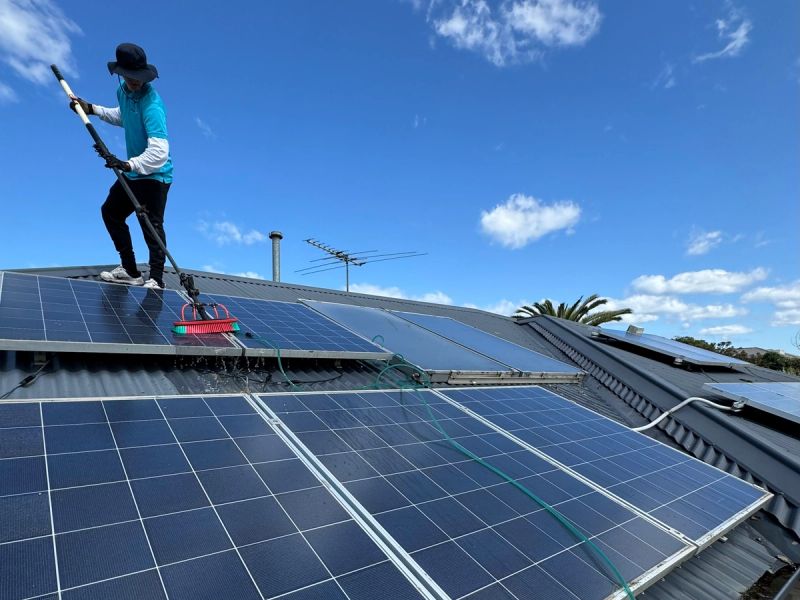
What a solar panel clean includes
The array is isolated before anything gets wet. Panels generate whenever there's light on them, so the system comes off first — that's not optional and it's not an upsell.
We wash with demineralised water. It carries no minerals of its own, so it lifts the film and dries without leaving the spotting that tap water leaves behind on glass. No abrasives, no scouring pads, no aggressive chemistry: the anti-reflective coating on a panel is thin, and once it's scratched it stays scratched.
Frames and edges are part of the job, not an extra. That's where growth starts, and cleaning the glass while leaving the frame is how the same problem comes back twice as fast.
What's not included. Three things sit outside the job, and it's better to say so here than on the day.
- Electrical work of any kind.
- Repairs, or replacing panels and fixings.
- Anything that needs a licence we don't hold.
If we find a cracked panel, a loose clamp or a cable sitting where it shouldn't, you get a photo of it and a plain description. We clean; we don't repair.
Solar panel cleaning cost in Melbourne
Solar panel cleaning cost is worked out per panel, because that's what actually drives the time on site. The rate drops as the array gets bigger.
from, per panel — fifty panels or more
from, per panel
from, per panel
Minimum call-out $220. All prices include GST.
How the job runs from quote to photos
You send the panel count and a photo or two of the roof. We come back with a price, not a range.
- On the day the array is isolated, the panels and frames are washed with demineralised water, and the surrounding roof gets a look while we're up there — blocked valleys and gutters above an array end up on the panels eventually.
- The system goes back on before we leave, and the photo report lands the same day: the array before, the array after, and anything we found that you'd want to know about.
- For arrays on a standing interval, solar panel maintenance in Melbourne usually settles into a rhythm after the first clean, once we've seen what the site actually collects and how fast.
- Nothing gets walked on. Panels are designed to carry weather, not people, and standing on glass is how micro-cracks start — the kind that don't show up until the string underperforms two summers later.
Google reviews
What clients said, straight from Google
Recent verified feedback from local clients who booked exterior cleaning with WaterCrew.
★★★★★ GoogleJuly 2026"Very happy with the service. They were clean, professional and left everything tidy Plus the job was done beautifully Many thanks!"
MelbourneView on Google ↗

★★★★★ GoogleJune 2026"Highly recommend Eren and his WaterCrew. Have used for gutter cleaning and will in future use for terracotta roof tile cleaning & window cleaning. They do a very thorough and professional job at competitive rates. Also, they are polite, friendly and well spoken."
CanterburyView on Google ↗

★★★★★ GoogleJune 2026"WaterCrew Cleaning recently cleaned the windows at my home in Chadstone and did an excellent job. The team was professional, friendly, and easy to deal with. The windows look crystal clear, and the service was completed on time and to a very high standard. I would highly recommend WaterCrew Cleaning to anyone looking for reliable window cleaning services in Chadstone."
MelbourneView on Google ↗

★★★★★ GoogleJune 2026"New age equipment, timely with very satisfactory results. Highly recommend crew for exterior/interior and flyscreen cleaning. Gutters cleaning available as well Best crew I came across for sometime and reasonably priced. Collin"
HamptonView on Google ↗

Who books a solar panel clean, and why
A home array returning less
The usual trigger is a quarterly bill that doesn't match the weather. Panels have been up five or six years, nobody has touched them, and the drop happened slowly enough that it never looked like an event.
A commercial roof
Bigger arrays, flatter pitch, and a finance person who can see the generation data. Commercial solar panel cleaning is nearly always a scheduled job rather than a one-off, because the numbers make the case on their own.
A farm or shed array
Dust is the whole story here. Harvest, stock movement and unsealed tracks put more on the glass in a week than a suburban roof sees in a season.
A managing agent or strata committee
Panels on a common roof belong to the building, not to any one lot, so the work gets arranged by whoever holds that responsibility — and needs a photo record for the file.
Questions we get asked before booking
Do I have to be home?+
No. The array is on the roof and the isolation point is outside on most systems. If we need access to a switchboard inside we'll say so when you book, otherwise it's a job you can be at work for.
Will you scratch the panels?+
Not with what we use. The wash is demineralised water with soft heads and no abrasive at all, which is the method panel manufacturers point to. Scratching comes from grit dragged across dry glass — that's why the surface gets wetted and lifted rather than scrubbed.
How long does it take?+
Most home arrays are done inside an hour or two. A large commercial roof is a half-day or more, depending on how the rows are laid out and how the roof is reached.
Can you clean panels in summer?+
Yes, but early. Glass on a Melbourne roof in February is hot enough to dry water the moment it lands, which leaves marks and wastes the wash. Morning work sorts that out.
What if a panel is already cracked?+
You'll get a photo of it and we'll leave it alone. A cracked panel is an electrical job for whoever installed it, and washing around damage isn't something to improvise on.
Do you clean the frames as well?+
Yes, and it matters more than the glass in the long run. Growth starts at the frame edge, so cleaning the panel face and leaving the frame just resets the clock for a few months.
Is bird mess included or extra?+
Included. It takes longer to soften than dust does, but it's part of what a clean is for, not a surcharge.
What happens if it rains after you've been?+
Nothing you'll notice. Rain on a clean panel runs off a clean surface; the problem was never the water, it was what the water was running over.
Recent solar panel cleaning jobs
 Solar panels
Solar panel cleaning on an apartment building on La Scala Avenue, booked by the body corporate. Around 30 panels across the roof of the four-storey block.
Read case study Solar panels
Solar panel cleaning on Grosvenor Street in Balaclava. The array on this single-storey terracotta tile home was heavily overgrown with moss.
Read case study Solar panels
Solar panel cleaning on a double-storey house on Testar Grove, Caulfield North. The array had built up grime with moss starting to take hold on the panel surfaces.
Read case studyWhy rain doesn't clean solar panels
Rain gets blamed for a job it can't do. Water landing on a panel picks up whatever is loose, runs to the low edge and evaporates — and everything it was carrying stays behind as a line along the bottom of the glass. Anyone who has looked at a windscreen after a shower already knows how this ends.
Two things make it worse on a roof. Solar panels sit at a shallower angle than most people picture, so water moves slowly and drops its load on the way down. And rain water isn't clean either: it collects dust on the way through the air and leaves the minerals behind when it dries.
So a wet week doesn't reset an array. It redistributes what's on it, concentrates some of it at the frame edge where growth likes to start, and buys a day or two of looking better from the ground.
The exception proves it. A steep array in heavy rain after a long dry spell does shift a surprising amount, which is why panels sometimes look better the morning after a storm. Give it a week of ordinary weather and the film is back where it was.
What the manufacturer's warranty says
Worth reading before anyone gets on the roof. Panel warranties generally set out how the surface may be cleaned, and the restrictions are consistent: nothing abrasive, no high pressure, no harsh chemicals, and no walking on the glass.
That rules out most of what makes a clean fast. Pressure washing a panel is the clearest example — it's quick, it looks effective from the ground, and it can drive water past the seal and take the coating with it. Damage of that kind is rarely covered, because it was avoidable.
If you're not sure what your system allows, the installer's handover pack usually has it. We'll work to it either way: the method we use is the conservative one regardless of brand.
One more thing worth checking: whether your warranty asks for cleaning records. Some do, particularly on commercial installations, and a photo report with a date on it is the simplest way to have that covered without keeping a file of invoices.
How to choose who cleans your panels
Solar panel cleaners are not a licensed trade, so the range in what's offered is wide. A few questions sort it out quickly.
Ask what water they use, and listen for whether the answer is demineralised. Ask how the array gets isolated, because anyone who hasn't thought about it hasn't done many. Ask what happens if they find damage — the answer should be a photo and a phone call, not a repair quote from a business that doesn't hold the licence for it.
Then ask about insurance, and about who is actually on the roof. Solar panel cleaning companies that subcontract at short notice can't always answer that second question, and it's the one that matters if something goes wrong on your property.
Finally, ask what happens to the water. On a roof it runs off wherever the roof sends it, so a contractor who hasn't considered the garden below, the pool, or the neighbour's paving hasn't thought the job through.
What solar panel cleaning should cost in 2026
Per-panel pricing is the honest structure, and any solar cleaning company that quotes without asking how many panels you have is guessing. The count drives the time, the height drives the access, and the pitch drives how long each row takes.
Be careful with a number that looks too low. Cleaning an array properly means isolating it, using water that doesn't leave deposits, and doing the frames — and a price that assumes a hose and twenty minutes is priced for a different job to the one described on this page.
Be equally careful with a number quoted sight unseen on a complicated roof. A steep two-storey tile roof with panels on two faces is not the same work as a flat commercial deck, and a quote that doesn't distinguish them will be corrected on the day, usually upward.
For what it's worth, our own solar panel cleaning services start at four dollars a panel on large commercial roofs and eight on a single-storey house, with a minimum call-out of two hundred and twenty dollars including GST. Those numbers are on this page for the same reason the method is: so you can compare like with like.
About the expert

Ihor Sydorenko
Founder & Lead Rope Access Technician (IRATA Level 3) — WaterCrew Cleaning
Ihor has worked on ropes since 2013, starting on high-rise facades in Kyiv, where he founded and still runs the rope-access company Альпіністи Київ. He holds IRATA Level 3 — the highest grade in the international rope-access system, covering work supervision, safety planning and rescue.
- ✓ IRATA Level 3 rope access technician
- ✓ Working safely at heights
- ✓ Construction induction
- ✓ First aid