
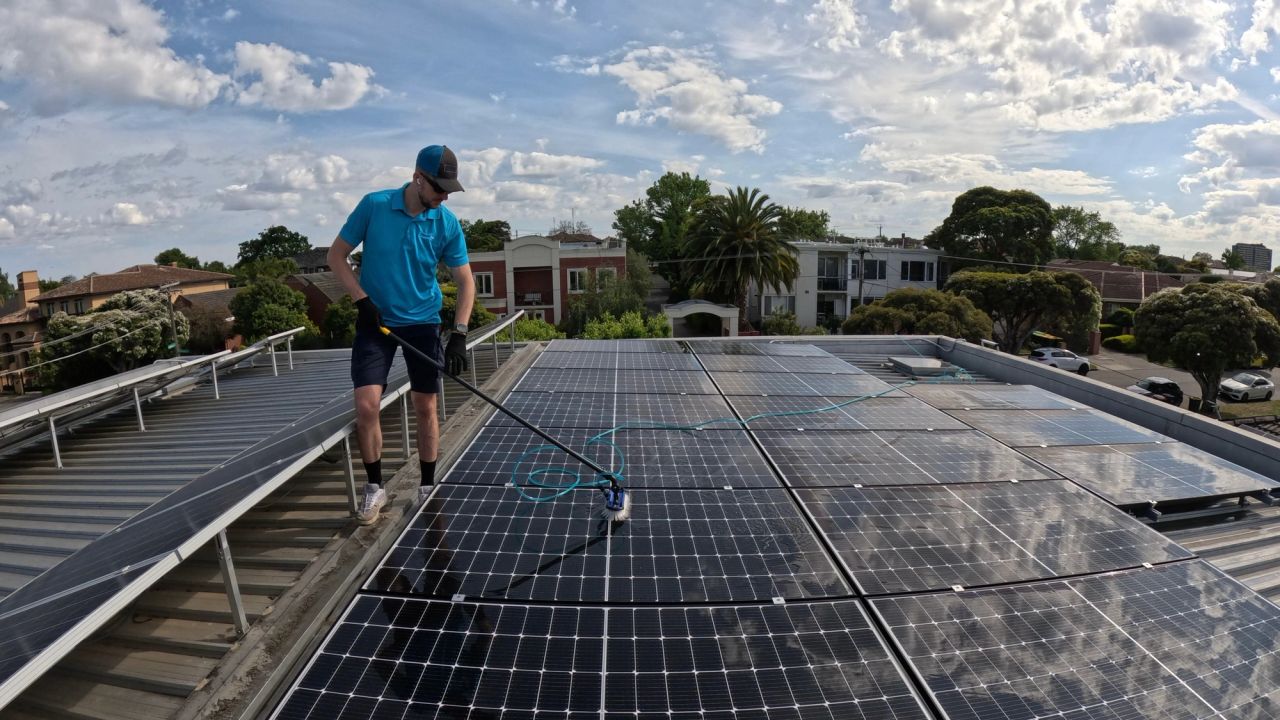
Cool panels, plain water, a soft brush on an extension pole, and nothing else. That is how to clean solar panels without damaging them, and on most Melbourne homes it is an early-morning job done from the ground. What harms panels is not the dirt — it is pressure washers, abrasive pads, household cleaners and cold water hitting hot glass. Every one of those is named in manufacturers' own cleaning instructions as grounds for voiding a warranty. Where the array is out of reach, that is the point at which [solar panel cleaning](/solar-panel-cleaning) becomes a job worth paying for.
Does a solar panel actually need cleaning?
Yes, but less often and less dramatically than most cleaning companies suggest. The International Energy Agency's Photovoltaic Power Systems Programme puts the cost of soiling at 3 to 5 per cent of annual PV energy production, and notes that after sunlight itself, soiling is the single most influential factor in what a system yields.
That figure is an average across every climate on earth, including deserts where it is far worse. A suburban roof that gets regular rain sits at the bottom of that range, not the top.
The mechanism is undramatic. A film of dust, pollen and exhaust soot scatters light before it reaches the cell. Nothing corrodes and nothing degrades — the panel simply receives less to work with. Measured on a rooftop array in a dusty climate, soiling accumulated at about 0.43 per cent a day through a dry spell, reaching 10.2 per cent over three and a half weeks without rain.
Melbourne rarely goes three and a half weeks without rain. That is the honest reason panels here need washing about once a year rather than once a quarter.
Before cleaning anything, open the inverter app. If this month is tracking with the same month last year, the glass is doing its job and there is nothing to fix.
Why rain does most of the work, but not all of it
Panel makers design for rain. REC states that its panels are built so that normal and regular rainfall will clean them naturally — with one condition attached to the same sentence: if installed at a sufficient angle.
That condition carries the whole claim. Water needs slope to carry dirt off glass. On a steep roof it runs. On a low-pitch array it spreads, slows and evaporates where it stopped, leaving the dissolved dirt behind as a line.
The measured evidence agrees with the manufacturer. In the rooftop study above, rainfall over 10 mm pushed soiling losses back to nearly zero. Rain is a better cleaner than the cleaning industry likes to admit.
What rain does not shift is specific and predictable. Bird droppings bake on and stay. Moss and lichen root along the frame edge rather than resting on it. And a dark band forms at the bottom lip of each panel, where the frame holds a few millimetres of water that evaporates in place, leaving everything it was carrying. That band is the single most common thing we get called out to.
So the useful question is not whether rain cleans panels. It is whether your roof has the pitch to let it.
The best way to clean solar panels at home
How do you clean a solar panel without taking risks with it? In order, and the first step has nothing to do with water.
Pick the time before anything else. Panels run around 20°C hotter than the air around them, and REC warns that putting cool water on hot glass can make components shrink fast enough to crack. Early morning, before the array reaches working temperature, is the window. Dusk works as well.
Look before you touch. A cracked or damaged panel is a shock hazard through leakage current, and REC notes the risk rises when the panel is wet. A visible crack, a scorched connector or a loose cable means stop and call the installer, not reach for a hose.
Then rinse. A standard garden hose at household pressure is exactly what REC recommends: enough water to run down the entire surface and float the loose material off. For most arrays the job finishes here.
If marks remain, use a soft sponge, a microfibre cloth or a non-abrasive brush on an extension pole — wet, and with almost no weight behind it. Never rub dry glass. Dragging grit across a dry surface is how the anti-reflective layer gets scratched, and that damage does not come back out.
Rinse again from the highest point down, so what you loosened leaves the array instead of settling lower on it. If your water leaves spots on a car, dry the glass rather than letting it air-dry.
That is the whole method, and the best way to clean solar panels really is the gentlest one that removes the film. If it sounds underwhelming, that is the point.
Skip the checklist
Get a fixed-price quote for your suburb
10 minutes. Insured local techs. Before-and-after photos every job.
What to clean solar panels with
Water, in almost every case. Where a mark will not lift, REC permits a mild, biodegradable washing-up liquid, applied and then rinsed off immediately with plenty of water.
That is the ceiling, not the starting point. First Solar's cleaning guidelines rule out abrasive cleaners and degreasers outright, and specifically prohibit any solution containing hydrochloric acid, D-limonene, ammonia or sodium hydroxide. Between them those cover a good share of what sits under a domestic sink, glass cleaner and degreaser included.
A bottled solar panel cleaning solution is rarely worth buying. The companies that manufacture the glass ask for water and, at their most permissive, dilute washing-up liquid. Anything stronger solves a problem you do not have while risking a coating that cannot be replaced.
Sprays sold as making panels self-cleaning sit in the same category. REC's guide states plainly that it provides no warranty for the application of any sprays or treatment.
Tools matter as much as chemistry. Knives, blades and metallic sponges are named by REC as not permitted, alongside pressure and steam cleaners.
Why the water matters more than the brush
Every mineral in the water you rinse with stays on the glass when it dries. That is what white spotting is: dissolved calcium standing where the drop sat.
First Solar puts numbers on it. Tap water with total hardness under 75 mg/L is acceptable. Between 75 and 180 mg/L the water has to be squeegeed off to stop scale building up. Reverse-osmosis water gives the best result, and REC's preference is deionised water for the same reason.
Australia's drinking water guidelines classify water under 60 mg/L as calcium carbonate as soft, and 60 to 200 mg/L as good quality. Your water retailer publishes the figure for your supply zone. If it comes in under 75, plain tap water is inside what the panel makers accept and drying is the only thing left to think about.
This is also the one real advantage a contractor has over a garden hose. Demineralised water dries without leaving anything behind, so the glass can be rinsed and left alone — and nothing touching the glass means nothing scratching it.
The coating most guides forget about
Most panels sold in the last decade carry an anti-reflective coating on the glass. It is what lets the cell use light arriving at a shallow angle, and it is a few microns thick.
It also changes the cleaning rules, which almost no consumer guide mentions. First Solar prohibits wet contact cleaning on coated modules altogether — squeegees, sponges, cloths, anything that combines water with wiping. Hard water is prohibited on them outright. Dry cleaning is permitted with soft cloths or mops, up to six times a year.
REC, facing the same question, permits a soft sponge or microfibre cloth on its panels. Both manufacturers are right, because they are describing different glass.
Which is the practical point of this entire article. The method is set by the manufacturer of your panels, not by a generic routine. The installation manual for your model is a two-minute read, and it is the only document that governs your warranty.
How to clean solar panels on a roof, and when not to
Everything above assumes you can reach the array safely. Most single-storey Melbourne homes with a low-pitch roof can be done from the ground with a water-fed pole, and for a homeowner that is genuinely the safest way.
Standing on the roof changes the risk entirely. Victoria's occupational health and safety regulations set the threshold for controlling a fall risk at two metres, and WorkSafe's compliance code for preventing falls in housing construction is built around that number. Those rules bind employers rather than a homeowner on their own roof — but the threshold is not arbitrary, and the gutter line of a single-storey house already clears it.
There is a second hazard with nothing to do with falling. An array in daylight carries enough voltage and current to be lethal, and First Solar's guidance is to clean only when modules are in open circuit or the inverter is off, in low light, and only by people who understand what applying water to a live electrical system means.
Tile roofs add a third problem. Terracotta cracks underfoot and the crack does not announce itself until the next heavy rain finds it, which turns a cleaning job into a roof plumbing job.
Second storey, steep pitch, or tile you cannot walk with confidence — the honest answer is that this is not a weekend job.
What the warranty actually says
This is the part worth reading before anyone points a machine at your roof.
REC's cleaning guide is unambiguous: the use of pressure or steam cleaners and high pressure hoses, knives, blades and metallic sponges is not permitted on REC panels and will invalidate the warranty. It adds that the product warranty is valid only if the installation manual is observed at all times.
First Solar allows pressure, but caps it. Water pressure must not exceed 35 bar at the nozzle, and the water must be within 20°C of the module's surface temperature. Failure to comply with the cleaning guidelines, it states, may void warranty.
Read those two together and the picture is clear enough. No manufacturer endorses a domestic pressure washer on a solar array. The machine that cleans a driveway does not belong near panel glass, and the damage it does — micro-cracks, water forced past the frame seal, a stripped coating — shows up as a slow decline in yield months later rather than as breakage on the day.
That delay is the reason to be careful now. Nobody connects a quiet drop in summer output to a wash done last spring.
How often to do it in Melbourne
Our recommendation for a typical Melbourne home is once a year, with output rather than appearance deciding when.
Move to twice a year if any of these apply: gums over the roof, a resident bird population, a low-pitch array where water sits instead of running, or a house near a main road, a rail line or the bay, where the film is soot or salt rather than dust.
Time it for the end of winter where you can. Spring and summer are when the array earns most, and a clean going into that stretch is worth more than the same clean in April.
Panels sitting below a solar hot water unit, an aerial or a chimney will always be the dirty ones, because whatever runs off lands on them. Cleaning those few is usually better value than doing the whole array.
What we would tell you not to bother with
A single-storey house, a low-pitch roof and a water-fed pole from the ground is a job to do yourself. It takes an hour, it costs the price of a brush, and paying somebody for it is paying for a ladder nobody needed.
Quarterly cleaning is a waste of money in this climate. So is cleaning panels that are not dirty, which is most panels most of the time.
Bottled cleaning solutions and self-cleaning coatings do not pay for themselves, and at least one manufacturer explicitly declines to warrant panels that have had them applied.
And if a company quotes for panel cleaning without asking what brand the panels are or what pitch the roof is, that is one method being applied to every roof. The manufacturers do not agree with each other on method. Anyone who has read their manuals knows that.
When it is worth paying somebody
Three situations, and they are the ones we actually get called for.
Height and pitch. A two-storey home, a steep roof, or tile that cannot be walked without cracking it. That is a rope-and-harness job or it is not a job at all.
Water quality and coated glass. If the supply is hard, or the panels carry a coating where contact cleaning is prohibited, the work needs demineralised water and a rinse that dries clean without anything touching the surface.
Systems where output has dropped and nobody knows why. Cleaning is often not the answer, and the useful outcome is a photographic record of the array and a straight answer about whether the problem is dirt or something an electrician should be looking at.
That is what our solar panel cleaning covers. Everything else on this page you can do yourself, and we would rather you knew which was which.
Want this done properly?
Free quote by suburb. If we service your area we'll usually have you booked within 5 working days.