
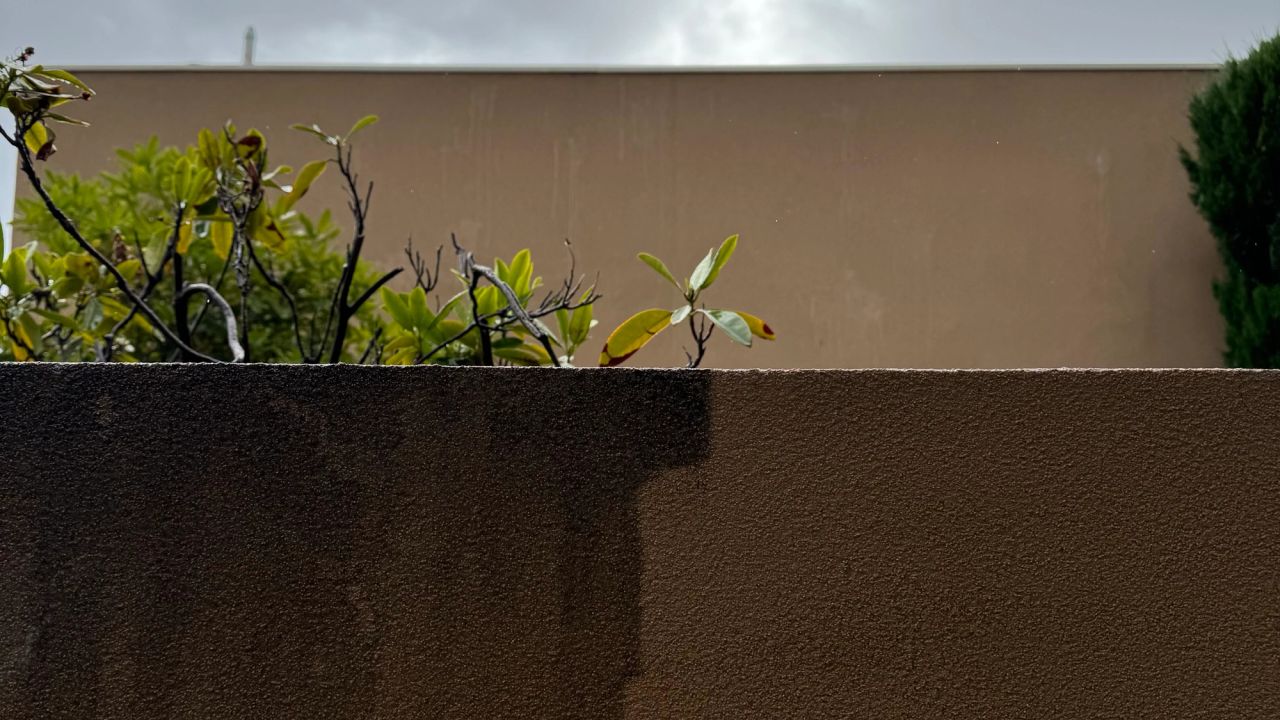
The short version of how to get rid of mould: remove it rather than kill it, then fix the water that fed it. Detergent or white vinegar handles most small patches indoors. Bleach mostly takes out the colour and leaves the rest behind. And when the mould is on the outside of the house rather than inside it, the cause is not damp air at all — it is shade sitting on a porous surface, and that is [house washing](/house-washing) rather than a spray bottle.
First: is it inside the house or on it?
Two different problems share one word, and almost every guide online mixes them. Sorting out which one you have takes ten seconds and changes everything that follows.
Inside the house, mould is a moisture and ventilation problem. Victoria's health service puts it bluntly: mould will only grow in damp unventilated rooms. The bathroom ceiling, the wall behind a wardrobe, the corner of a bedroom that never gets sun. Air holds water, the coldest surface in the room takes it, and growth starts there.
Outside the house, air has nothing to do with it. A facade is ventilated by definition. What grows there is a film of mould, algae and lichen living on a surface that stays wet longer than it stays dry — a south elevation, a wall under deep eaves, brickwork behind an overgrown shrub.
The organisms overlap. The cause does not, and neither does the fix, so how to remove mould depends entirely on which of the two you are looking at. Everything from here is marked as one or the other.
One spelling note while we are here. Australian and British English use mould; American sources use mold. If you searched how to get rid of mold and landed on US pages, their advice assumes a different climate and a different way of building walls — which matters considerably more than the extra letter does.
One boundary up front, because it decides whether this page is useful to you: we clean the outside of buildings. Interior remediation — cutting out plasterboard, drying structure, treating a cavity — is a different trade with different licensing, and we do not do it.
Mould needs three things, and you control one
Spores, a surface, and water. That is the whole list.
Spores are in the air everywhere and always will be — there is no version of your house without them, and any product promising to remove them is selling you something that does not exist.
The surface matters more than people think. Growth sits on glass and steel and washes off. It gets into render, mortar, aged paint, plasterboard and timber, because those have pores to get into.
Water is the only one you control, which is why every authority on the subject says the same thing about it. Better Health Channel: the best way to control mould growth is to control moisture, and unless you identify the source and remove it, the problem is likely to recur. The US Environmental Protection Agency says it more flatly in its guide to mold, moisture and your home: “If you clean up the mold, but don't fix the water problem, then, most likely, the mold problem will come back.”
The World Health Organization reached the same conclusion from the health side. Its guidelines on dampness and mould name persistent dampness as the thing to prevent, and link damp indoor environments to higher rates of respiratory symptoms, allergy and asthma.
So the cleaning is the easy half. The half that decides whether you do it again next winter is the water.
What actually removes mould, and what only hides it
Here is the sentence that reframes the whole job, from the EPA: “Dead mold may still cause allergic reactions in some people, so it is not enough to simply kill the mold, it must also be removed.”
That one line settles how to clean mould in practice: the target is removal, and killing is only a step on the way there if it is a step at all.
Read that twice if you have ever sprayed something on a patch and walked away. A product that kills growth and leaves it in place has done half a job, and the visible half at that.
For a small patch indoors, what Victoria's health service recommends is unglamorous: household detergent or white vinegar is sufficient in many cases. Use a microfibre cloth, and rinse it in a separate container of clean water rather than the one you are cleaning with, so you are lifting growth off rather than spreading it around.
Ventilate the room while you work. The recommended protection is more than most people expect for a bathroom ceiling — gloves, eye protection, and a P1 or P2 mask.
And some people should not be doing it or be in the room while it happens: pregnant women, children, and anyone with a weakened immune system or chronic lung disease. That is not our caution, it is the health service's.
Skip the checklist
Get a fixed-price quote for your suburb
10 minutes. Insured local techs. Before-and-after photos every job.
Why chlorine is the wrong default
Chlorine bleach is what most people reach for, and the EPA's position on it is explicit: “The use of a chemical or biocide that kills organisms such as mold (chlorine bleach, for example) is not recommended as a routine practice during mold cleanup.”
The reason is what bleach does and does not do. It takes the colour out of the stain very effectively, so the wall looks fixed within minutes. On a porous surface the growth underneath is still there, now invisible, and it keeps going.
Black mould removal is where this misfires most often, because the black is the thing people want gone and bleach removes the black faster than anything. What it leaves behind is a wall that reads clean and is not.
There is also a safety line worth taking seriously. Better Health Channel warns: “Do not mix bleach with ammonia, acids or other cleaners – this can release hazardous chlorine or chloramine fumes.” Vinegar is an acid. Anyone who tries the vinegar advice, gets impatient and reaches for bleach is one step from making gas in a closed bathroom.
Bleach is not useless. On hard, non-porous surfaces — tile, glazed surfaces, sealed benchtops — it does what it says. It is the wrong default for anything with a pore in it.
Vinegar, peroxide and the natural options
White vinegar is the one a health authority actually names, alongside plain detergent, and it is cheap enough that there is no reason to start anywhere else indoors.
Hydrogen peroxide mould removal comes up constantly in searches. It works on hard surfaces and it lifts colour, much like bleach does. What is worth knowing is that no Australian health authority names it as the recommended agent — Better Health Channel names detergent and vinegar. That is an absence of endorsement rather than a warning, and it is worth stating as exactly that rather than dressing it up either way.
Natural does not mean harmless. Vinegar is an acid, and the fume risk above is real. Tea tree oil, clove oil and the rest of the home-remedy list have their advocates and no health-authority backing, which puts them in the same category as peroxide: possibly fine, not recommended by anyone accountable.
The honest summary is that the agent matters far less than people want it to. Removal and moisture control do the work. The bottle is a detail.
Mould on paint, and why ceilings go first
Ceiling mould cleaning is the most common indoor version of this job, and ceilings go first for reasons of physics rather than neglect. Warm wet air rises, the ceiling is usually the coldest surface in the room, and that is where the water condenses. A bathroom ceiling with no working extraction fan will grow mould no matter how often it is wiped.
Mould on paint divides into two cases. If the paint film is sound, cleaning mould off it is a cloth-and-detergent job — the growth is sitting on top rather than in anything. If the paint is chalking, flaking, or the growth has reached the plaster underneath, wiping only removes the visible layer.
The EPA is direct about where that ends: absorbent or porous materials may have to be thrown away, because mould can fill the crevices of porous materials and become difficult or impossible to remove completely.
That is the point at which cleaning stops being the answer and repainting or replacing starts. Anyone who tells you otherwise about soaked plasterboard is selling a wash.
How to remove mould off walls on the outside
Outside, the diagnosis is easier: look at which wall it is on. South and south-east elevations in Melbourne get the least sun and dry the slowest, and that is where the film shows up first. So does anything under a deep eave, behind a shrub that was planted too close, or on the shaded side of a fence line.
What is growing there is usually a mix — mould, algae, sometimes lichen where it has been left long enough — and on a rendered or painted wall it reads as a grey-green haze before it reads as spots.
The method is the same idea as indoors, scaled up and slowed down. A cleaning solution goes on, it is given time to work, and it comes off with a low pressure rinse. Contact time does the job that force would otherwise be asked to do.
Work bottom to top when applying and top to bottom when rinsing. Solution running down a dry wall leaves streaks that dry in place and show up worse than the original growth did.
Cover what you care about below. Anything that lifts growth off render will also do things to a garden bed it was never asked to do.
Why exterior mould always comes back
It comes back. Not because the wash failed, but because the conditions that grew it are still there, and no wash changes which way a wall faces.
The mechanism is the one the EPA describes for porous materials: growth fills the crevices, which makes complete removal difficult or impossible. Render, mortar joints and aged paint are all porous. A wash takes the colony off the surface and out of the top of the pore. What sits deeper survives.
So the honest promise is a clean wall for a period, not a sterile one forever. How long depends on the aspect, the overhang, the planting and the surface — not on the product.
Anything sold as permanent mould treatment for a facade is a claim nobody can keep. If a quote includes that word, ask what happens in the second winter.
What you can change is the input. Cut the shrub back off the wall, clear the gutter that is spilling down one corner, and fix the downpipe discharging against the render. Those move the timeline further than any chemistry does.
What a soft wash does that a hose cannot
A garden hose wets a wall. That removes dust, and dust was never the problem.
A soft wash is chemistry plus time plus a rinse gentle enough that the wall survives it. The solution goes into the pore where the growth actually lives, it is left long enough to work rather than blasted off after twenty seconds, and the rinse carries the dead material away instead of leaving it in place to grey off again.
That last part is the bit most people skip, and it is the one the EPA singles out indoors: killing is not the same as removing. On a facade it plays out as a wall that looks clean for a month and then does not.
Mould treatment on a rendered wall is therefore a slow job by design. If somebody is finished in an hour on a full elevation, they rinsed it.
Why pressure makes an outside wall worse
Pressure is the instinct, and on a facade it is the one thing that makes the next occurrence arrive sooner.
Acrylic render is a thin coloured coat over a soft base, and a lance held close cuts a hard-edged line through it that never blends back. Old lime mortar erodes out of the joint. Paint lifts at the sills first, because trim is softer than the wall and closer to where the operator stands.
But the argument that matters is not damage, it is recurrence. Force leaves a rougher, more open surface than it found. More pore means more places for the next colony to sit, and it fills faster than the smooth one did. Pressure-clean a rendered wall and you have bought a shorter interval, not a longer one.
There is one honest exception, and it is the same one as everywhere: sound concrete and hard paving take real pressure. A wall does not.
When it is your job, and when it is ours
A patch on a bathroom ceiling or a bedroom wall is yours. Detergent or vinegar, a cloth, ventilation, and then the real fix — an extraction fan that runs, a window that opens, a wardrobe pulled off the wall by an inch. Calling anyone for that is paying somebody to wipe.
It stops being yours when it keeps coming back over a large area. Better Health Channel's line is that if large areas of mould regrowth occur, consult a mould remediation professional — and that is a remediation specialist, not us. We clean exteriors. We will say so rather than take the job.
Outside, a single-storey wall you can reach from the ground is a weekend with a soft brush and patience. Ours is the rest: full elevations, second storeys, render you cannot test without risking the coat, and walls where the growth has been there long enough that lichen has taken hold.
That is what house washing covers, and the packages start at $420 for a single-storey home.
The rest of this page you can act on today without calling anybody, and we would rather you knew which half was which.
Want this done properly?
Free quote by suburb. If we service your area we'll usually have you booked within 5 working days.