
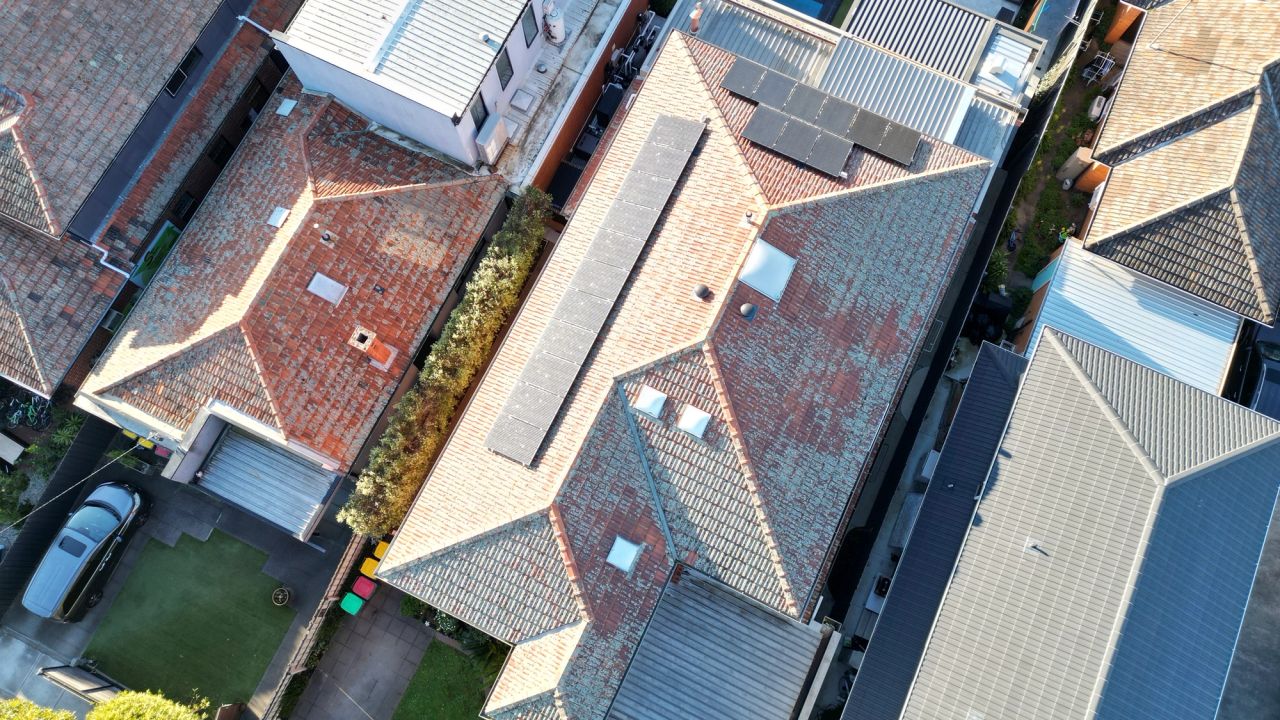
There is no way to remove lichen from roof tiles in an afternoon. Moss lifts off wet and comes away in sheets, but lichen is chemically bonded to the surface it grew on, so it is killed first and released over the weeks afterwards by rain and weather. Anyone promising a bare roof by the end of the day is using pressure or a scraper, and both damage the tile faster than the lichen does. The slow method is the only one that leaves the roof intact, and that is [cleaning roof tiles](/roof-tile-cleaning) rather than a weekend job.
Moss or lichen? They are not the same thing
Look at the roof from close up, or at a photo taken from a drone. Moss is green, soft, and stands up off the surface in a cushion. It has structure you can see.
Lichen is flat. It reads as a grey, sage or rust-coloured crust that looks painted on, often in rough circles that spread outward from a centre. On a terracotta roof it is usually pale grey-green against orange.
The reason they behave so differently is that they are not the same kind of organism. The Australian National Botanic Gardens puts it plainly: a lichen is not a single organism, it is a symbiosis between a fungus and an alga or cyanobacterium.
The alga carries the chlorophyll and makes the carbohydrate. The fungus cannot make its own, so it harvests some of what the alga produces, and in exchange it provides the structure and a stable place to live. That partnership is what lets lichen colonise bare rock — and a roof tile is bare rock as far as it is concerned.
Moss is a plant. It has no true roots, it absorbs water across its whole surface, and it needs a surface that holds moisture rather than one it can attach to chemically.
Why the difference decides the method
Moss sits on the roof. It holds onto texture, silt and the roughness of an aged tile, but it is resting there. Wet it, and it lifts in sheets.
Lichen is attached. The fungal filaments grow into the surface itself, which is why a scrubbing brush takes the tile with it or takes nothing at all.
That single fact rearranges the whole job. Moss can be removed. Lichen has to be killed where it stands and then given time to let go — a solution is applied, the organism dies, and rain and thermal movement release the residue over the following weeks and months.
It also explains the complaint that comes up most in this trade. A roof treated for lichen looks barely different on the day. Six weeks later it looks like a different roof. Anyone who needs the before-and-after photo on the same afternoon is going to be sold pressure instead, and that is the expensive mistake.
How growth actually damages a roof
Two different mechanisms, and the research on historic buildings describes both.
Lichen works mechanically and chemically at once. A review of biodeterioration in historic buildings describes the mechanical half as penetration of the fungal hyphae into the substrate, causing loss of cohesion as the body of the lichen contracts and expands with every wetting and drying cycle.
The chemical half is acid. The same review lists the organic acids lichens produce — citric, oxalic, lactic and gluconic — as the means by which they decompose the mineral constituents of the surface they are on.
Moss does not do that. Its damage is indirect and it is all about water: mosses retain moisture and nutrients, and that accumulated moisture is what promotes deterioration and weathering of the material underneath.
On a roof, both routes end in the same place. A tile that has lost its surface takes up water instead of shedding it, gets heavier, grows more, and freezes and thaws with more water inside it than it was designed to hold.
Skip the checklist
Get a fixed-price quote for your suburb
10 minutes. Insured local techs. Before-and-after photos every job.
Lichen on roof tiles, and on Colorbond
Terracotta has a fired glaze on the face, and that glaze is what sheds water. Lichen etches into it. Once the glaze is compromised the tile underneath is porous, so it holds water, grows faster and gets heavier every winter. Terracotta is also brittle with age, which rules out anything mechanical.
Concrete tile is the one people expect to be tougher and it is the worst of the group. Its colour sits in a surface coating rather than through the body, and once that coating has worn thin the body is porous. Growth roots into the tile instead of sitting on it, and clearing it is slow work that cannot be rushed.
Lichen on Colorbond roofs behaves differently again, because there is nothing porous for it to get into. It attaches to the coating rather than into the sheet, so it comes off more readily — but abrasives and scrapers will take the factory coating with it, and a stripped coating is a rust problem two winters later.
Older galvanised and zincalume are the ones to be careful with. They are usually already rusting at the laps, and the wash is as much about not making a hole as about removing anything.
The pattern across all four: the growth is rarely the expensive part. The surface underneath it is.
What roof moss removal actually involves
Roof moss removal and lichen treatment are two jobs that usually happen in one visit, and they run in a specific order.
First the loose material comes off. Moss cushions, leaf litter in the valleys, anything sitting rather than attached. This is volume, and taking it off first means the solution that follows reaches the tile instead of soaking into a mat of vegetation.
Then the roof moss treatment goes on: a solution applied at low pressure across the whole surface, valleys and ridge included, and left. It is not rinsed off aggressively, because contact time is the entire mechanism.
Then the gutters get cleared, after the roof rather than before it. Everything that comes off a roof lands in them, and doing it in the other order means doing it twice.
Then you wait. Dead lichen releases over weeks as the roof wets and dries. Knowing how to remove moss from the roof properly is mostly knowing that the last stage is not something you can accelerate.
Copper strips, chlorine and moss killers
Copper or zinc strips fixed near the ridge are the most common preventive sold. The idea is sound in principle: rain carries metal ions down the roof and those ions inhibit growth. The practical limits are less advertised — the effect reaches only a short distance down the slope, it works slowly, and it does nothing to what is already there.
We have not found independent testing that settles how well they work on Australian tile roofs specifically, so treat anyone quoting a percentage as making it up. On a roof that already has lichen, strips are not the answer to the problem you currently have.
Chlorine bleach is the other reflex. It takes the colour out of the growth quickly, so the roof looks improved within an hour, and that is exactly the trap: the organism is still attached and still etching. It also runs off into whatever is planted below.
Bottled moss killers sold for roofs are mostly the same active ingredients as what a contractor applies, at a fraction of the concentration and none of the coverage. The bottle is not the problem. Getting it onto every square metre of a roof you should not be walking on is the problem.
The honest version: nothing prevents growth on a shaded, north-facing-away roof under trees. You can slow it. Cutting the branch that keeps the roof wet does more than any product on this list.
Why pressure washing a tiled roof backfires
Pressure removes lichen. It also removes the glaze on terracotta and the colour coating on concrete tile, and those are the two things standing between the tile and water.
The result is a roof that looks dramatically better on the day and grows back faster than it did before, because the surface is now rougher and more porous than the one the lichen originally colonised. You have bought a shorter interval.
Then there is the roof itself. Tiles are loose components resting on battens. Water driven uphill under them goes into the roof space, and aged terracotta cracks underfoot in a way that does not show until the next heavy rain finds it.
There is one honest exception. A concrete tile roof in sound condition with nothing but grime on it takes real pressure and comes up well. That exception is why the method has a reputation it only half deserves.
When moss on roof tiles is not worth removing
Not every patch needs treating, and the research is less one-sided than the industry likes to admit.
The same review notes cases of bioprotection rather than biodeterioration: on some stone the oxalic acid reacts with the substrate to form a crystal patina around the lichen that shields the surface. The authors go as far as saying that where lichen growth does not damage a monument, its presence can even enrich the building's cultural value.
A roof is not a monument, and a modern tile is not weathered sandstone, so do not read that as permission to leave a colonised roof alone forever. Read it as a reason to be sceptical of anyone describing every speck of moss on a roof as an emergency.
The practical line we use: light surface growth on a sound roof with no lifting and no valley blockage can wait for the next scheduled clean. Growth that is holding water in the valleys, spreading under the tile laps, or sitting on a coating that has already gone chalky should not.
If somebody quotes you for an urgent treatment on a roof they have not photographed from above, that is a sales process rather than an assessment.
When roof lichen stops being a job you can do
Roof lichen on a single-storey, low-pitch roof you can treat from an edge or a pole, without walking on tiles, is a job you can do. The product is available, the method is not complicated, and the patience is free.
It stops being that at a few clear points: a pitch you cannot work from the edge, terracotta old enough to crack under weight, or a second storey. Add any roof where the valleys are already blocked, because that is a plumbing problem hiding under a cleaning problem.
The other reason to hand it over is coverage. A treatment that reaches eighty per cent of a roof leaves twenty per cent to recolonise the rest, and from the ground you cannot tell which eighty you got.
What we do is cleaning roof tiles: the material decides the method, the roof gets photographed before and after, and the timeline is explained before anyone quotes a result.
And if the honest answer for your roof is that it can wait a season, we would rather say that than sell you a wash you did not need.
Want this done properly?
Free quote by suburb. If we service your area we'll usually have you booked within 5 working days.