Gutter Cleaning — Auburn Grove, Armadale
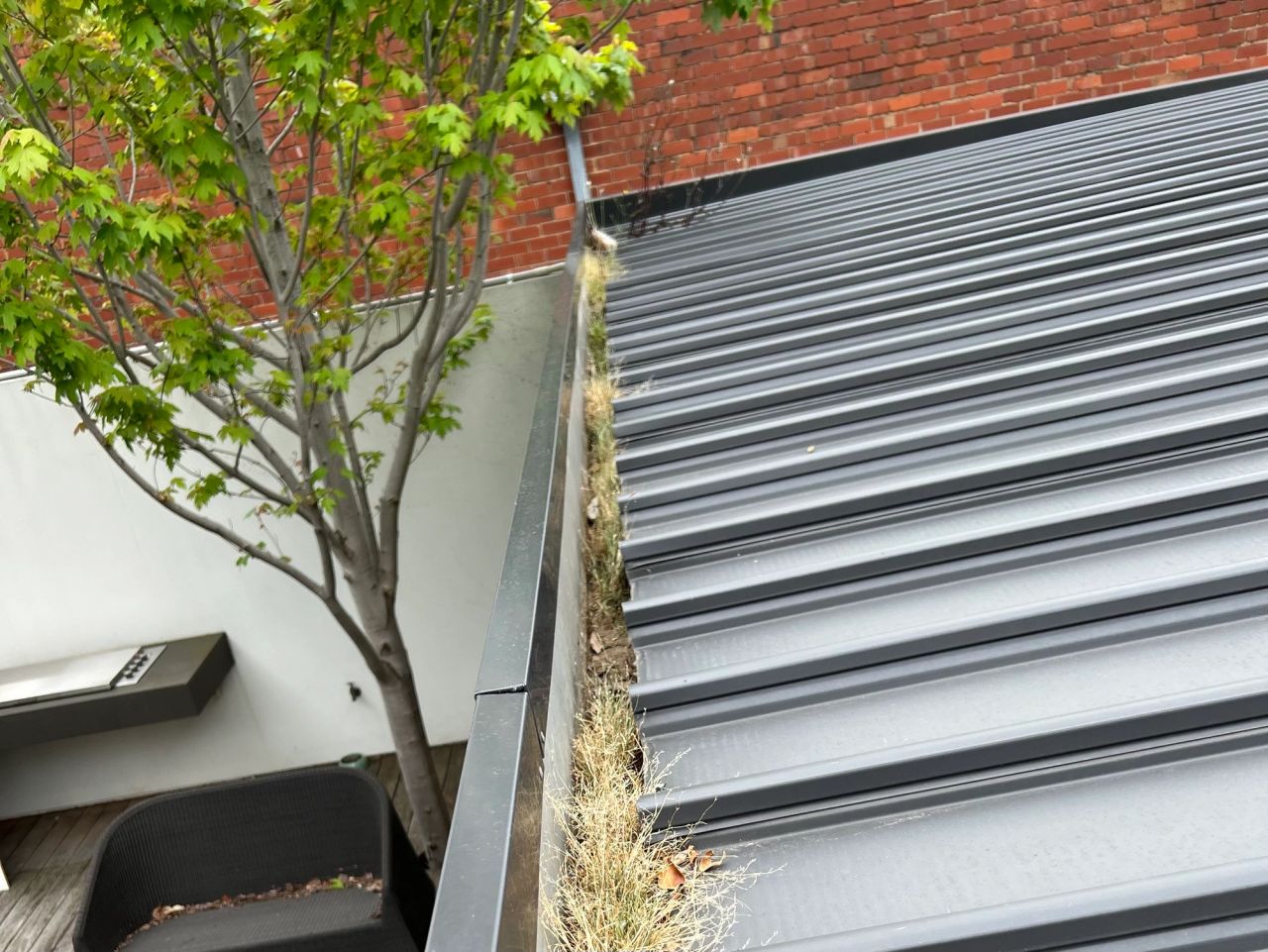
Gutter cleaning on a house on Auburn Grove, Armadale, a street that runs down to High Street. The gutters had not been touched in years and there was grass growing along the length of them, on a sheet metal roof. One technician, five hours. Everything came out by hand first, and only then did any pressure go near a downpipe. That order is not a preference.
- Location
- Armadale 3143
- Completed
- 31 October 2024
- Crew
- 1 tech
The problem
Grass tells you how long it has been, and it also tells you what is underneath it. Not leaf, but the soil leaf eventually turns into, with a root system running through it that holds the whole length of the run together as one piece. The temptation with a blockage in that state is to put pressure straight on it, because pressure is quick and the material is heavy and nobody enjoys lifting it by hand. On a gutter this far gone, that is the single thing that makes it worse.
What we did
Pressure into a gutter full of rooted material does not remove the material. It breaks the fine fraction off it and sends that straight down the downpipe, where it settles at the first bend and sets. You end up with a gutter that looks clear from the ladder and a downpipe that is now solid, which is the harder of the two problems and the one you cannot see. So the whole run came out by hand first. Grass, root mat and the soil underneath it, lifted out rather than pushed along, until there was nothing left in the gutter that water could carry anywhere. Only then did the downpipes get pressure, and at that point it does exactly what it is good for: clearing the line instead of feeding it. Each outlet was checked for flow afterwards rather than assumed clear. One technician, five hours. This is the kind of job that does not get faster with a second person, because pulling a rooted run out is sequential work along one gutter rather than something two people can split between them.
- Full gutter run cleared by hand before any water was used
- Grass, root mat and accumulated soil lifted out rather than pushed along
- Downpipes pressure-flushed only once the gutters were empty
- Flow checked at each outlet after flushing
- Worked from ladders, with no access onto the sheet metal roof
- Debris bagged and taken away rather than left on site
Result
- One technician, five hours
- Gutters and downpipes both clear, and in that order
- No fine material driven into the downpipes during the clean
Nearby case studies
More projects in Armadale
 Window cleaning
A two-storey apartment building on Orrong Road, Armadale, with timber-framed windows cleaned from the outside. Two technicians, four hours.
Read case study