Exterior Cleaning in Malvern
Boom-era and Edwardian roofs that drain into themselves rather than off their edges, on a suburb that has barely changed. Insured crew, photos on every job.
- $20M public liability insurance
- Police-checked, WorkSafe compliant
- 5.0 from 170 Google reviews
- Not happy with the work? You don't pay

Malvern was a city in its own right until 1994. It took its name from the Malvern Hill Estate, where lots were first sold in 1856, became a borough in 1901 and a city in 1911, and was only merged with most of Prahran into Stonnington on 22 June 1994.
What built it was trams. The Prahran and Malvern Tramways Trust formed in 1908, and between 1910 and 1915 four routes were electrified along Glenferrie, Wattletree, High and Malvern Roads. The housing went up beside them, which is why so much of the suburb is Boom-era and Edwardian rather than anything later.
It has also barely changed size. Just over nine thousand people live here on under three square kilometres, and that figure has moved very little across three censuses. Unlike the suburbs being replaced block by block further out, Malvern keeps the buildings it has, so maintenance here is cumulative. Nothing gets reset by a rebuild.
And a roof from that period does not behave like a modern one. That is the part worth understanding before anybody quotes you.
Where the water actually goes up there
This is what the top of a Malvern street looks like, and almost nobody who lives on one has seen it. Gables meeting at angles, valleys running between them, parapets standing proud of the roofline, and several separate planes on a single house.
A post-war house drains outward. Water runs down one or two simple planes into an eaves gutter hung on the edge, where you can see it from the garden. A roof like this drains inward: into the valleys between the gables, and on the larger houses into box gutters sitting behind those parapets.
That difference decides how a problem announces itself. A blocked eaves gutter overflows over the fascia, down the wall, in front of you. A blocked valley or box gutter has nowhere to spill to on the outside, so it backs up under the tiles or over the internal edge, and the first anyone knows of it is a stain on a ceiling. By then it has been wet up there for a while.
So two things follow. The clean has to include the valleys and the hidden runs rather than the eaves line alone, which is gutter cleaning done properly rather than quickly. And the photographs stop being a nicety: on a house like this there is no spot on the ground you can stand and check the work from, so the pictures are the only way you ever see your own roof. Where the covering itself needs attention, that is roof tile cleaning, and anything that needs more than cleaning goes to a roof plumber rather than to us.
The same roof, at civic scale
The Town Hall sits on the north-east corner of Glenferrie Road and High Street. Its foundation stone went down on 22 September 1885 and it opened on 26 July 1886 to plans by Wilson and Beswicke, with a second tower and the extended Glenferrie Road frontage following in 1890 and a clock presented in 1891. It was remodelled again through 1926 and 1927.
Look at the tower roofs. They are French Second Empire, and they are built out of fish scale slates, circular vents and a great deal of lead. That is the civic-scale version of what is on the houses behind it: a roof assembled from hundreds of small overlapping pieces, with lead doing the waterproofing at every junction rather than a single sheet doing it across the lot.
Which is why nothing on a roof of that construction gets walked on or pressured. Slates are nailed, brittle and thin, and lead flashings move if you lean on them or drive water under them. The work happens from the edge, from ladders and by extraction, and anything out of reach that way is quoted as out of reach rather than attempted.
Below the roofline the same restraint applies to the walls. Render and stone of that age want a solution and a low-pressure rinse rather than force, which is facade cleaning on a building this size and house washing on the ones behind it. The council moved its offices across the road in 2015, but the hall is still in use, and it is still the clearest thing in the suburb to point at when explaining why an old roof is not a modern one.
Services we run in Malvern
The work we take on around Malvern. Each card opens the full service page.
Gutter cleaning
Vacuumed, downpipes flushed and flow-tested, photo report the same day.
See detailsSolar panel cleaning
Panels washed with demineralised water, frames included, output stops dropping off.
See detailsRoof cleaning
Terracotta and Colorbond, moss and lichen treated to slow regrowth.
See detailsWindow cleaning
Glass, frames and tracks, inside and out, streak-free on the dry check.
See detailsPressure cleaning
Driveways, paving and concrete brought back without scarring the surface.
See detailsSoft washing
Render, cladding and painted surfaces washed at low pressure.
See detailsJobs we've finished in Malvern
 Gutter cleaning
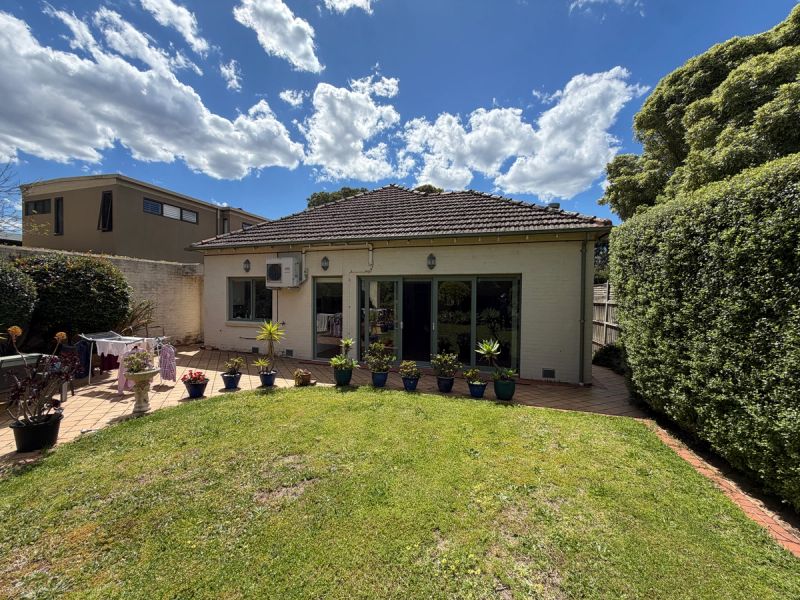
A single-storey house on Mountview Road, Malvern, where the gutters are cleared every six months and the downpipes had blocked anyway. Gutters, downpipes and all the glass inside and out, in one visit.
Read case study Window cleaning
A residential apartment building on High Street, Malvern, where no single method reaches all the glass. Telescopic poles from the ground wherever there was ground, and rope access for everything else.
Read case studyWhat owners here ask before booking
Our gutters were cleared last year and water still came in. How?+
Most likely because what was cleared was the eaves line and the problem is somewhere else. On a house of this era the valleys between gables and any box gutter behind a parapet do as much of the draining as the gutters on the edge, and plenty of quotes do not include them. Worth asking any quote, including ours, exactly which runs are covered.
Can you actually show me what my own roof looks like?+
Yes, and on a house this size that is the point of the photographs rather than a courtesy. There is no position in your garden or on the footpath from which the valleys and the parapet gutters are visible. You get pictures of each run before and after, which is the only practical way to know what is up there.
What is a box gutter, and do we have one?+
It is a gutter that sits inside the roof rather than on its edge, usually behind a parapet wall. The quick test from the street is whether a section of wall stands up past the roofline instead of stopping at it. If it does, there is very likely a gutter behind it, and it is the run most often missed.
Can a valley be cleared without anyone walking on the roof?+
Usually, yes. Valleys are worked from the edge and from ladders, with vacuum extraction rather than by someone standing in them. Walking a hundred-year-old tile or slate roof is where a great deal of avoidable damage comes from.
The house is tall. Do the windows need scaffolding?+
Rarely. A water-fed pole reaches two storeys from the ground, which covers most of Malvern, and nothing then leans on the facade or the joinery. Above that it depends on the building, and we will tell you before the quote rather than after.
Rated by Melbourne
Malvern jobs are posted to our Google profile with before-and-after photos as they finish.