Building Facade Cleaning Melbourne
Render, brick, metal cladding and precast washed at low pressure, by rope access or boom lift. Two technicians minimum, from $1,320 per building.
- $20M public liability insurance
- Police-checked, WorkSafe compliant
- 5.0 from 170 Google reviews
- Not happy with the work? You don't pay
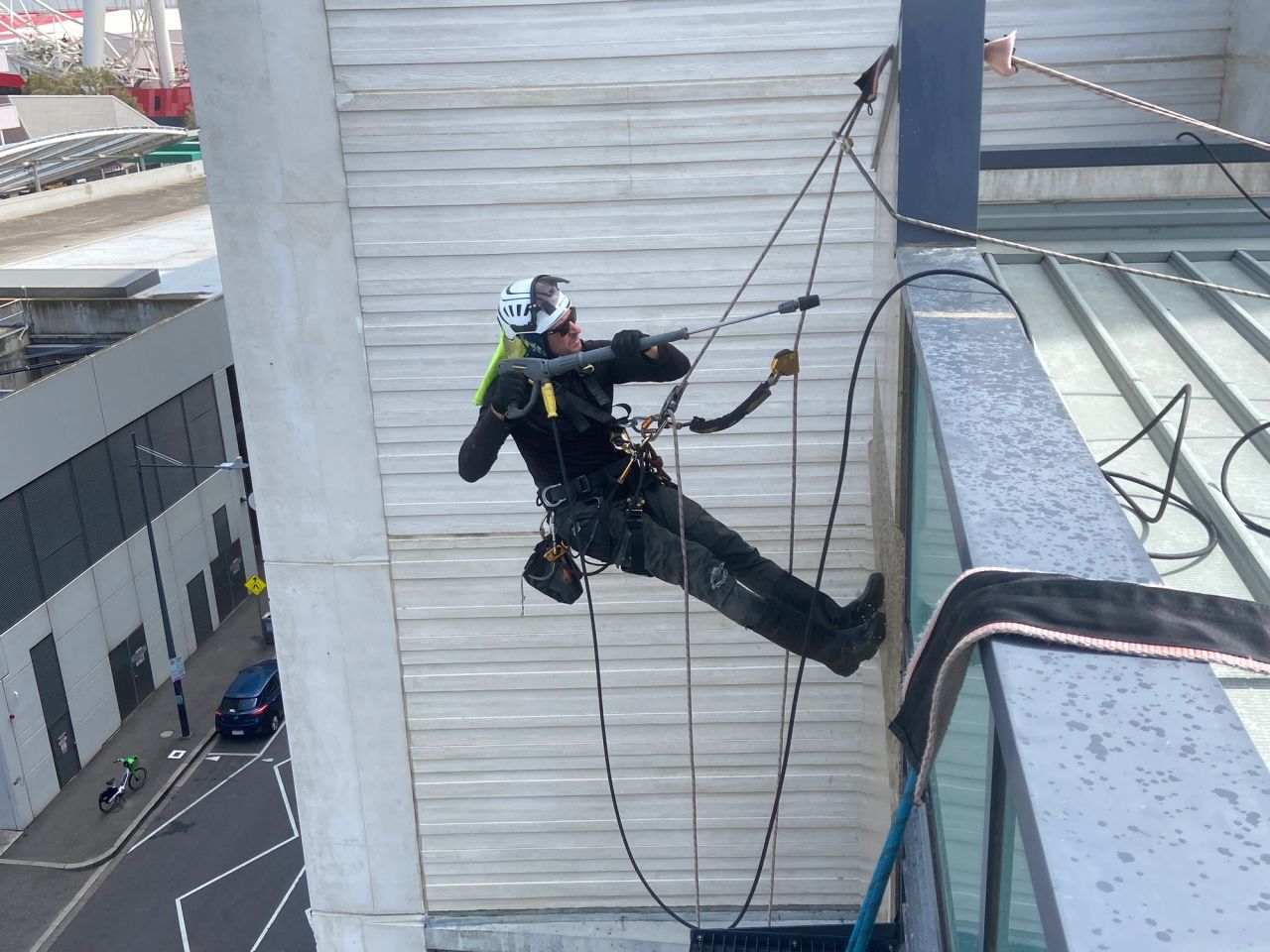
Facade cleaning is priced by the building, not by the square metre. A wash starts at $1,320 with two technicians on site, and the figure moves with height, access and what the walls are made of.
Building washing here covers render, texture coat, painted cladding, face brick, precast concrete and metal sheeting, on offices, apartment blocks, hotels and strata-managed buildings. Low pressure and a cleaning solution do the work. We clean the surface. We do not paint it, patch it or re-coat it.
Below three storeys a building can usually be reached from the ground. Above that it is a boom lift or rope access, and that one decision, more than the size of the wall, is what sets the price.
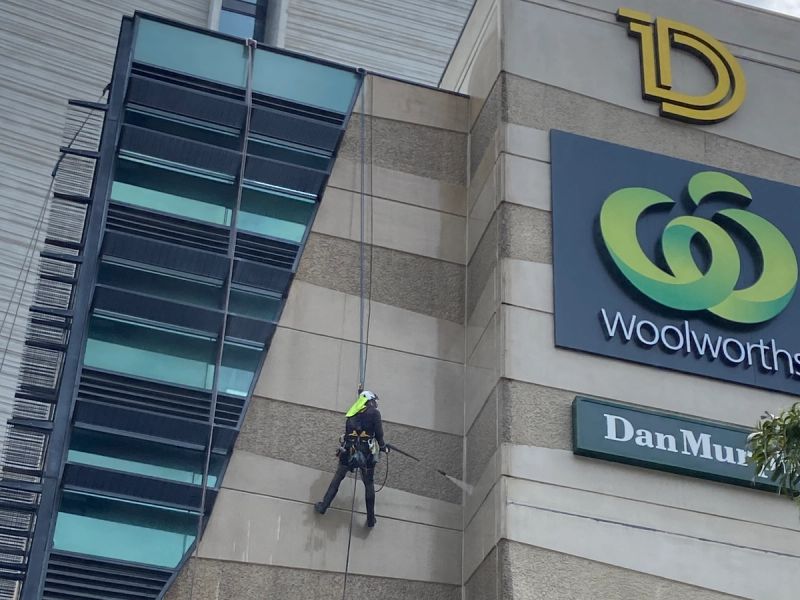
What happens to the building while we wash it
Nothing closes. Offices trade, guests check in, residents come and go, and the wash works around all of it. A building wash is planned around the building's day rather than around the crew's.
- Before anyone arrives, the building gets a notice it can send out: which elevations, which days, and what tenants and residents need to do. Windows shut, balconies clear, nothing left on a sill. We write it and whoever manages the building sends it, because it lands better coming from them than from a contractor.
- Entrances stay usable. A building wash that costs a tenant a day of trade has not saved anybody anything, so where a lift takes carpark bays it takes them for the day and gives them back, and where the work sits over a footpath there is signage and somebody on the ground the whole time it is live.
- Trading hours are the usual constraint. A retail frontage or a hotel entrance cannot be wet at nine in the morning, so those faces are done early, late, or on the quiet day of the week. It costs more per hour and it is almost always the right call.
- Photographs come at the end, before and after, elevation by elevation. On a shared building the person paying is rarely the person who watched the work happen, and a set of images settles that faster than a description does.
Where a strata is a row of single-storey villa units rather than a building, the work and the pricing sit on house washing instead.
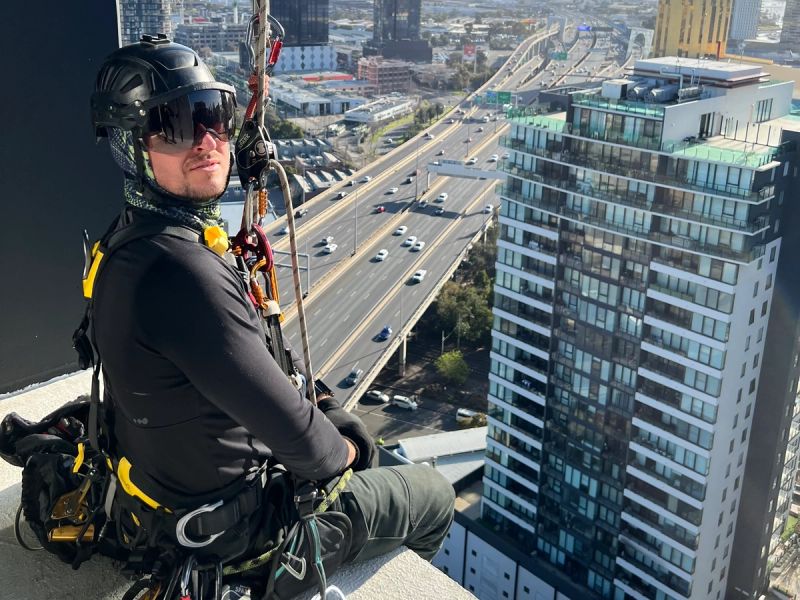
Render cleaning, brick and metal cladding
Render cleaning is the most common request on this page and the least forgiving job on it. Acrylic render is a thin coloured coat over a soft base. Pressure that a concrete driveway would shrug off cuts a line straight through it, and that line never blends back in. Render comes clean with solution, contact time and a rinse, and with nothing else.
- Texture coat behaves the same way over a rougher surface. It holds more of whatever lands on it, so render cleaning on a texture-coated wall needs longer contact rather than more force.
- Face brick is hard, but the mortar between it is not. Older buildings near the bay were laid in lime mortar, and a high pressure lance will hollow it out joint by joint faster than you would believe. Brick gets low pressure for the same reason a heritage wall does.
- Metal sheeting and Colorbond cladding come clean quickly. The sheet is not the problem. The laps, the fixings and the sealed joints behind them are, because that is where forced water finds a way in.
- Precast concrete panels take more pressure than anything else here, and even on precast it is the joint sealant that sets the limit, not the panel.
Where a building has a glass and aluminium curtain wall, the glazing is done in the same visit, and that side of the work is high-rise window cleaning. Tagging is different again: a different product and a different method, quoted on its own as graffiti removal.
What bad facade cleaning does to a wall
Most of the facade damage we get asked to look at was done by a cleaner rather than by weather. The same six failures come up, and every one of them costs more to put right than the wash cost in the first place.
- Render cut through. A render cleaner holding a lance too close leaves a hard-edged track in the coloured coat. It cannot be washed out and it cannot be blended, so it is a re-coat.
- Mortar washed out. Lime and old sand mortar erode under pressure, and the joint keeps taking water long after the wall has dried.
- Water behind cladding. Forced up under a lap or into a sealed joint, water sits in the cavity where nothing dries it.
- Sealant lifted. Joint sealant between panels goes brittle with age and peels once pressure catches an edge.
- Paint stripped off the sills. Trim goes first, because it is softer than the wall and closer to where the operator is standing.
- Streaking that sets. Solution run down a dry wall from the top dries in place and leaves a pattern that reads worse from the street than the dirt did.
None of that is exotic. It is what happens when a method built for driveways gets pointed at a wall, and it is the reason a facade quote reads differently from a concrete quote.
Building facade cleaning prices in Melbourne
A facade cleaning quote carries one fixed number and that is the minimum. Everything above it is quoted after somebody has looked at the building, because two buildings of the same size can sit thousands apart once the access is worked out.
from — two technicians, one day, an elevation within reach from the ground
The minimum includes GST, the cleaning solution, ground protection and the crew. Boom lift hire, traffic management and any permit for a footpath closure are quoted as separate lines, so you can see what is access and what is washing.
What moves a building wash quote up or down
Seven things move a facade quote, and square metres is not the first of them. Two buildings with identical wall area can sit thousands apart once you work out how a technician gets to the wall.
- Access method. Ground and pole is cheapest. A lift is next. Rope access costs the most, because it takes trained technicians and a rigging check before anyone loads an anchor.
- Height. Not for the extra wall, but because every extra band is another reposition.
- Cladding. Render and old brick are slow and cautious. Precast and metal are quick.
- How many elevations. A free-standing building has four. A building in a row has one or two, and that halves the job.
- What is underneath. A footpath, a carpark in use, or a courtyard with planting all have to be protected and controlled, and one of them needs a permit.
- Hours. Work outside trading hours on a shop or a hotel frontage is a different rate to work on a Tuesday morning.
- Water. A usable tap on site is assumed. Where there is none we bring water, and it goes on the quote as its own line.
The quote lists these separately rather than folding them into one rate, so a committee comparing two prices can see where the difference actually sits.
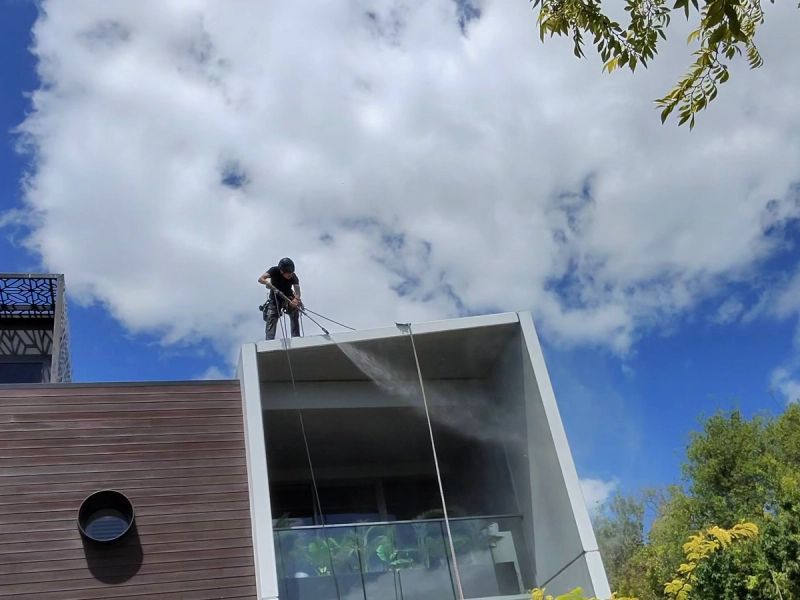
Rope access, boom lift or ladder work
There are three ways to reach a wall, and the building picks which one, not the crew and not the budget. Getting that decision right before the quote is written is most of the job.
- Ladders and water-fed poles cover the first three storeys on most buildings. It is the cheapest access there is, and where a building allows it the quote stays near the minimum.
- A boom or scissor lift comes next. It needs hard standing, a clear route in from the street, and often a permit if it has to sit on the footpath. Hire and traffic management appear on the quote as their own lines.
- Rope access takes over where a lift cannot reach or cannot stand: a laneway elevation, an internal courtyard, a tower. Anchors are checked before anyone loads them. On a hotel in Albert Park we worked four days off ropes with three technicians to cover the full envelope.
Whichever one it is, a ground zone goes in underneath before the first drop of water. Cones, signage, and a spotter wherever the public keeps walking past.
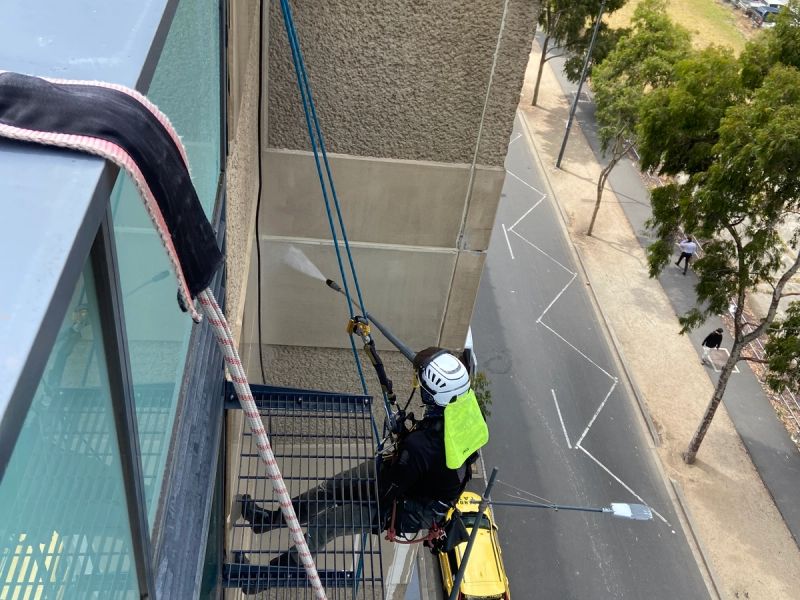
How a facade cleaning job runs, day by day
The first day starts before any water. We walk the elevations, note what is loose or already damaged, bag or tape whatever cannot get wet, and confirm the access plan with whoever manages the building.
Then the wash. Solution goes on from the bottom up, so nothing runs down a dry wall and streaks. It sits while it works. It comes off from the top down at low pressure. Windows and sills take the run-off, so glazing is cleaned after the walls and never before them.
On a tower the work runs elevation by elevation and band by band, which is why a large building is measured in weeks. Three towers on Gladstone Street in South Melbourne took a crew of four around three weeks between them.
Each face is finished before the crew moves to the next one, so a building is never left half-washed over a weekend with the line showing from the street.
Facades and walls we have washed recently
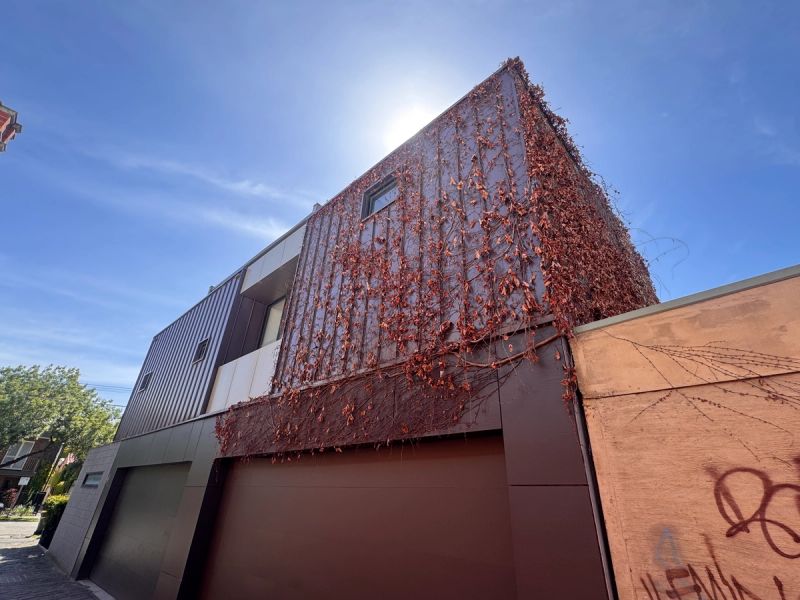
Dried ivy stripped off the walls of a house on Lodge Street, St Kilda West, in January. Pulling the growth down is the quick part — what it leaves behind is the job.
Read case study
Google reviews
Ratings and comments people left on Google
Recent verified feedback from local clients who booked exterior cleaning with WaterCrew.
★★★★★ GoogleJuly 2026"Very happy with the service. They were clean, professional and left everything tidy Plus the job was done beautifully Many thanks!"
MelbourneView on Google ↗

★★★★★ GoogleJune 2026"Highly recommend Eren and his WaterCrew. Have used for gutter cleaning and will in future use for terracotta roof tile cleaning & window cleaning. They do a very thorough and professional job at competitive rates. Also, they are polite, friendly and well spoken."
CanterburyView on Google ↗

★★★★★ GoogleJune 2026"WaterCrew Cleaning recently cleaned the windows at my home in Chadstone and did an excellent job. The team was professional, friendly, and easy to deal with. The windows look crystal clear, and the service was completed on time and to a very high standard. I would highly recommend WaterCrew Cleaning to anyone looking for reliable window cleaning services in Chadstone."
MelbourneView on Google ↗

★★★★★ GoogleJune 2026"New age equipment, timely with very satisfactory results. Highly recommend crew for exterior/interior and flyscreen cleaning. Gutters cleaning available as well Best crew I came across for sometime and reasonably priced. Collin"
HamptonView on Google ↗

Who books a building wash, and why
An owners corporation
Common walls, shared cost, and a photo record for the file. Usually scheduled rather than reactive, because on a shared building nobody owns the decision until the complaints start.
An office or retail frontage
The wall is the first thing a customer reads about the tenant. These jobs are often out of hours, because the entrance cannot be wet at nine in the morning.
A hotel or serviced apartments
Occupied the whole time, so the work is planned around guest windows and balconies rather than around the crew. Rope access usually, lifts rarely.
A builder at handover
New render and new cladding come out of a site covered in construction film. It has to be off before the keys change hands, and the deadline is somebody else's settlement date.
Wall cleaning services for strata committees
A committee does not buy the way an owner does. The quote goes to a meeting, sits beside two others, and has to be readable next to both of them.
So the scope is written to be read: which elevations, which surfaces, what access, how many days, and what is excluded. Certificates of currency go out with it rather than after it. If the building needs a notice to residents about closed windows and wet paths, we write that too and the committee sends it.
Wall cleaning services on a strata building are also the easiest thing in this trade to under-scope. A quote that covers the street elevation and quietly leaves the laneway out will always look cheaper on the page. Ours names every face, including the ones nobody photographs. Wall cleaning services written that way take longer to put together and are a great deal harder to argue with afterwards.
Cleaning render without stripping the coat
Cleaning render is a chemistry job with a time limit, not a pressure job. The solution does the lifting, the wall holds it long enough for that to happen, and the rinse is soft enough to take off the growth and leave the coat.
It is a fair question to put to any render cleaner before they start: what pressure, and why that pressure. An answer that opens with a number rather than with the condition of the coat is the wrong answer.
Two things go wrong. The wall dries before the solution has done anything, which happens on a hot north face and is handled by working in sections and at the right end of the day. Or the solution is left too long on a coat that is already chalking, and the colour comes away with the dirt.
So an old wall gets a patch tried somewhere the street cannot see it, and we say up front when a wall is past washing and into repainting. We do not paint or patch render, so there is nothing in it for us to pretend otherwise. Cleaning render on a mid-rise is the same judgement call as on a house, made off a rope instead of a ladder.
Building washing on a cycle, not on complaint
Most buildings get washed when somebody complains. A tenant sends a photo, an agent gets a call, the committee moves. By then the growth has had a full season and the wash takes longer than it needed to.
On a cycle it is a smaller job every time. A building washing schedule set once and repeated costs less per visit than the same building cleaned reactively, because the crew is taking off a film rather than a colony.
How often depends on the aspect more than on the calendar. A south elevation that never sees sun, a wall under trees, or a building near the bay where salt sits on everything will all come due sooner than a dry north face two suburbs inland.
There is no building washing rule we can hand you from a desk. Ask at the end of a job and we will tell you what the wall looked like underneath and what that means for timing.
Questions strata and facility managers ask
Why is the minimum $1,320?+
Because a facade takes two technicians and a day whatever its size. Nobody works at height alone, and the second person is on the ground managing the zone underneath. A half-day rate on a building does not exist.
Do you use high pressure at all?+
On precast concrete and hard paving, sometimes. On render, texture coat, brick and cladding, no. The solution does the work and the rinse only carries it away.
Will the wash damage the paint?+
Sound paint is fine. Paint that is already chalking or lifting will show it, which is why an old coat gets a test patch first and why we say so before starting rather than afterwards.
Can you work outside business hours?+
Yes, and on retail and hotel frontages it is usually the only way. It is quoted at a different rate and it needs the building to arrange access.
Do you need a tap on site?+
We assume one. If the building has no usable outlet we bring water, and it appears on the quote as its own line rather than inside the rate.
What happens to the windows?+
They take the run-off from the walls, so glazing is cleaned after the facade rather than before it, in the same visit. On a fully glazed tower that part is quoted as high-rise window cleaning.
Are you insured for work at height?+
Yes, and the certificates of currency go out with every facade cleaning quote rather than being produced later. Rope access work is done by technicians trained for it, not by whoever is free that week.
How long does a building take?+
A building wash on a low-rise in reach from the ground is a day. A mid-rise on a lift is several. A tower on ropes runs into weeks: three towers in South Melbourne took a crew of four around three weeks.
About the expert

Ihor Sydorenko
Founder & Lead Rope Access Technician (IRATA Level 3) — WaterCrew Cleaning
Ihor has worked on ropes since 2013, starting on high-rise facades in Kyiv, where he founded and still runs the rope-access company Альпіністи Київ. He holds IRATA Level 3 — the highest grade in the international rope-access system, covering work supervision, safety planning and rescue.
- ✓ IRATA Level 3 rope access technician
- ✓ Working safely at heights
- ✓ Construction induction
- ✓ First aid