Commercial Window Cleaning Melbourne
Offices, warehouse units and body corporate buildings. Glass above ladder height, reached by pole from the ground or by lift. Not street shopfronts. From $429.
- $20M public liability insurance
- Police-checked, WorkSafe compliant
- 5.0 from 170 Google reviews
- Not happy with the work? You don't pay
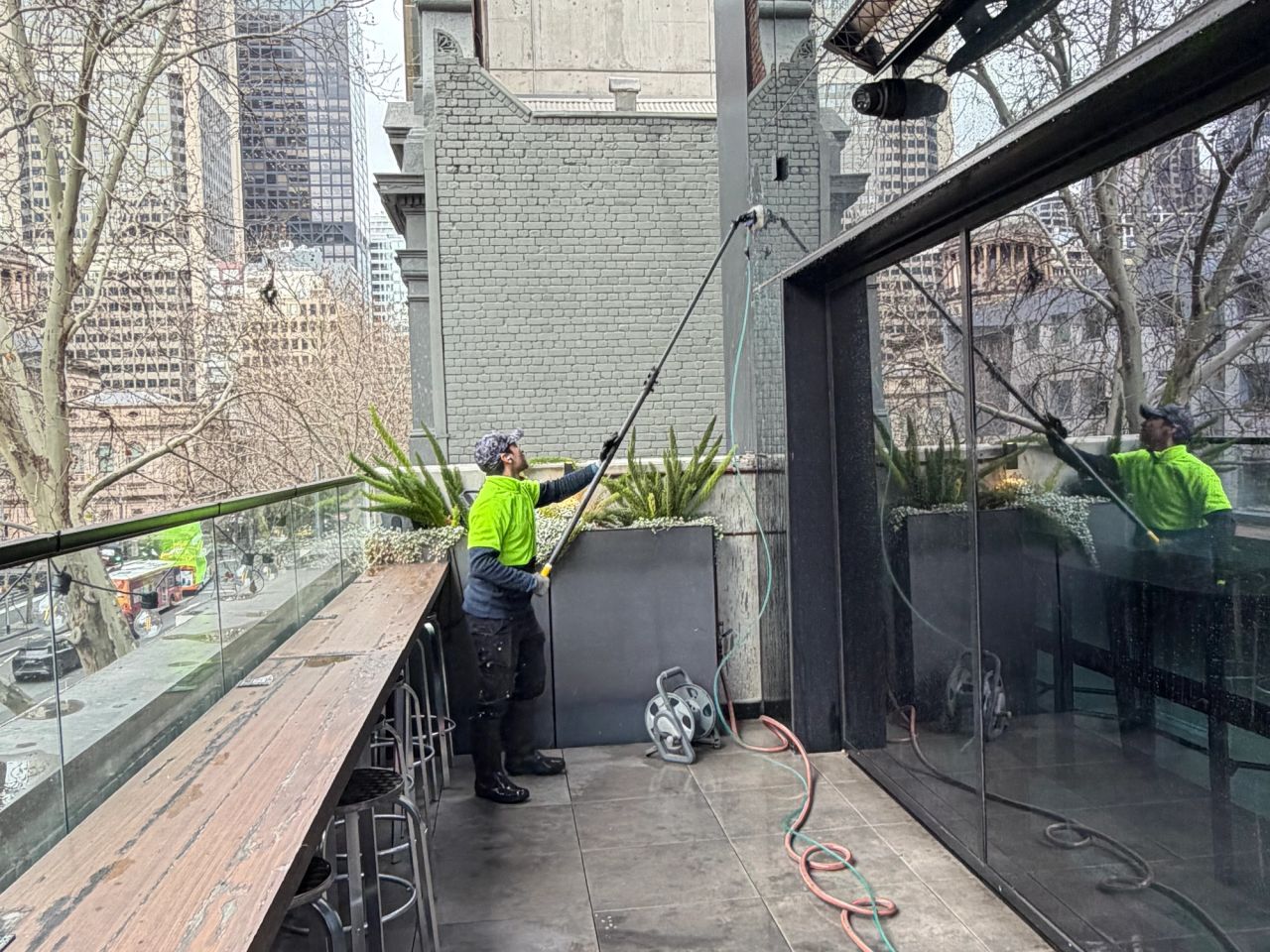
Commercial window cleaning starts at $429, and the thing that decides the price is not the size of your business. It is how the glass gets reached.
Offices, office-and-warehouse units, body corporate and multi-tenant buildings. Glass that sits above ladder height, on a building that is open for business while we are on it.
One thing we do not do, and it is worth saying in the first paragraph rather than in the small print: street-level shopfronts. The weekly retail round with a bucket and a squeegee is a different business from this one, and we are not in it. If that is what you need, you want a local window round, not us.
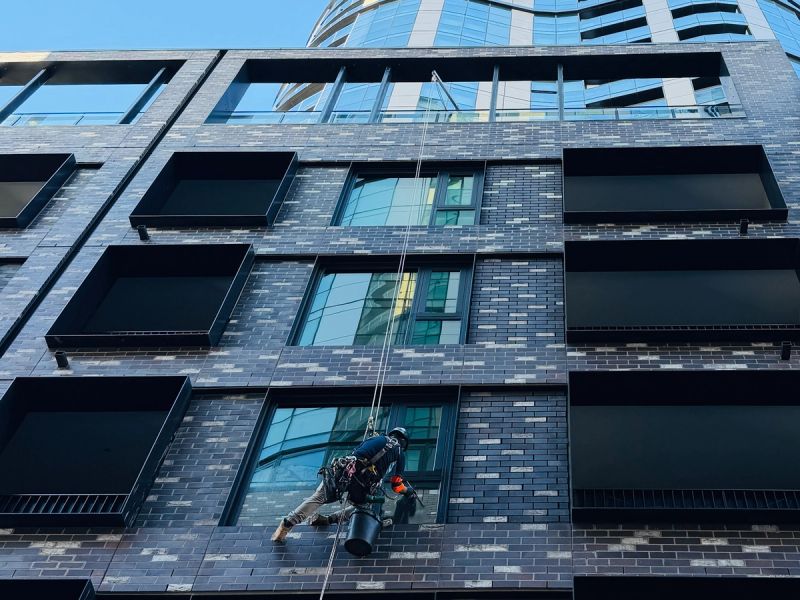
Where a pole stops and a lift starts
Three ways to reach commercial glass, and the building picks one. The price follows the method, not the square metres.
A water-fed pole from the ground. Purified water up a carbon pole, brushed and left to dry without a squeegee. It reaches roughly four storeys, it needs nothing closed off, and it is by a wide margin the cheapest method for window cleaning buildings of that height. Most office and warehouse glazing in Melbourne is inside its range.
Rope access. Above what a pole reaches, the first question is whether the building has somewhere to anchor. Where it does, the work goes onto ropes, and that is a different service set out on high rise window cleaning.
A lift. Where there is nothing to anchor to, a boom or scissor lift is the way up instead. It needs ground to stand on and a clear route in, and what that costs is worked out on the building rather than read off a list.
Most buildings never get past the first of these. A quote that reaches for a machine on a four-storey office is quoting the expensive version of a job a pole would have done from the footpath.
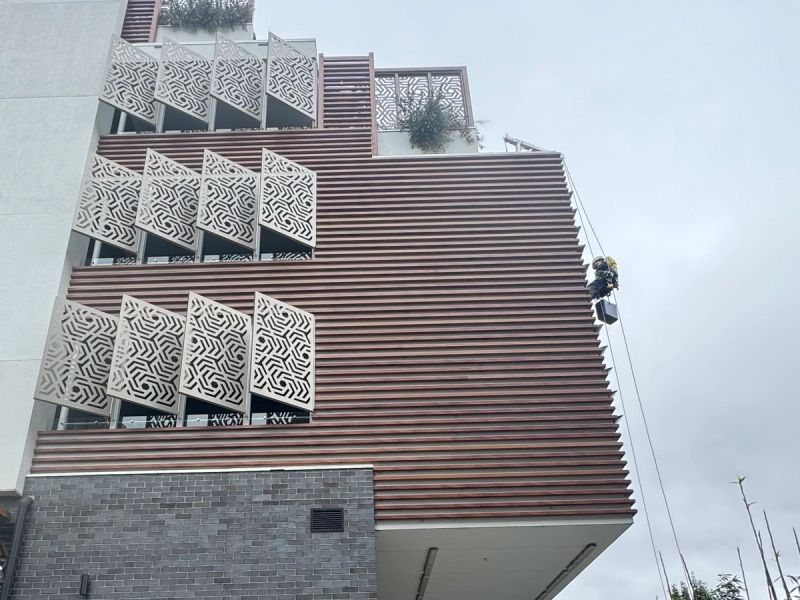
What a building gets that a house does not
A house is cleaned when the owner is home. A building is cleaned around everybody else, and that is most of what separates a commercial job from a residential one.
- Hours that suit the building. Ground-floor glass on a busy entrance gets done early or late. A warehouse dock gets done when the trucks are not on it.
- Paperwork before the date. A Safe Work Method Statement written for your building, certificates of currency, and induction cards for whoever is attending. Sent before the booking is confirmed rather than after it.
- Public liability of $20 million. The certificate goes out with the quote if you want it. On a building with tenants and a footpath underneath, that number is the point.
- A notice your tenants can be sent. We write it, you send it under your own name. It lands better from the building than from a contractor.
- A photo record. Before and after, the same day, which matters when the person paying is not the person who saw the work.
None of this is unusual for the industry. What is unusual is how often it turns up late, after somebody has already agreed a price.
Working around a building that is open
Six steps, and the first three happen before anyone brings a pole onto the site.
- 1
The building is looked at, not the address
Storeys, how far the glass is set back, whether a lift can stand where it would need to, and where the water can come from. Most of it is answerable from photographs and a look at the frontage.
- 2
The access method is worked out on the building
Pole from the ground, ropes where there is something to anchor to, a lift where there is not. Some of that is answerable from photographs and some of it needs eyes on the anchors.
- 3
Hours agreed, paperwork sent
Early, late or during trade, whichever costs the building least. The SWMS, the certificates and the tenant notice go out before the date is confirmed.
- 4
Ground level set up and kept clear
Signage, cones and a walkway that stays open. On a building with a public footpath this is the part that goes wrong for other people, and it is the part that gets a building manager a phone call.
- 5
Glass cleaned top down
Purified water so nothing is left to dry on the pane, worked downward so no finished glass is rinsed over again on the next pass. Frames and sills where they are in scope.
- 6
Photographed and reported
A set of photographs and a short written note of anything found — failed seals, cracked panes, a sill holding water. You get told; we do not fix it, because that is a glazier's trade.
Commercial window cleaning prices in Melbourne
Three ways of being priced, and the building decides which one applies rather than you do. A small block has a minimum. A building with a lot of repeated glass is priced per window. And where a pole will not reach and there is nothing to anchor to, the work goes up on a lift and is priced like rope access, because it is the same day of work reached a harder way.
from — two or three storeys, exterior glass reached by pole from the ground
from, per window — the rate that takes over on buildings with a lot of repeated glass
from — a lift where there is nothing to anchor to, priced as rope access is
All prices include GST. The per-window rate is a volume rate: below about eighty-five windows the minimum works out cheaper and that is what you are charged, so a small block is never quoted per pane. Footpath permits, traffic management and out-of-hours loading are quoted separately. Interior glass is a separate visit.
What moves a commercial window cleaning quote
Building window cleaning is priced on how the glass is reached, not on how much of it there is. Five things move the figure, and the number of panes is only one.
- The access method. A building the pole reaches and a building that needs a lift are different jobs at the same height. This is the single biggest line in any commercial quote.
- Whether the ground is available. A lift needs hard standing, a clear route in, and sometimes a footpath permit. Where the ground has to be closed, that is a cost of access rather than a cost of cleaning, and it is quoted separately.
- The hours. Work outside trading hours costs more than work during them. Sometimes it costs the building less overall, because nobody is being walked around a wet entrance.
- Inside as well as out. Interior glass is a separate visit organised through the building, because it needs access to occupied floors and it does not need the same equipment.
- How often. Buildings on a schedule are cheaper per visit than the same building cleaned once after somebody complained, because glass kept clean never reaches the state that takes a day to reverse.
Nothing here is charged by the hour. Commercial window cleaning services quoted hourly move the risk of a difficult building from the contractor onto the tenant, and a building is exactly where that risk lives.
Who books a commercial window washer
An office building
Tenant-facing and judged on it. These run to a calendar rather than to a complaint, and the facilities manager wants the paperwork before the price.
An office and warehouse unit
High glazing on the office frontage and higher glazing down the warehouse wall. Usually one visit, usually a pole, and usually booked around the loading dock.
A body corporate or multi-tenant block
Common glass, shared cost, and a committee that has to compare quotes. The photo record matters here as much as the glass does.
A building already on a schedule
Cheaper per visit than the same building cleaned once after somebody complained, because glass kept clean never reaches the state that takes a day to reverse.
Commercial buildings we have worked on
 Window cleaning
External window cleaning on a hotel building on Exhibition Street, carried out from ground level with a water-fed pole system reaching around 18 metres.
Read case study Window cleaning
External window cleaning on an office building on Lorimer Street, Port Melbourne. Glass only, reached from the ground, with nothing closed off and nobody inside the building interrupted.
Read case study Window cleaning
External window cleaning on a three-storey office building on Shearson Crescent. Around 150 windows were cleaned from ground level using a water-fed pole system, in a single day.
Read case study
Google reviews
What building managers wrote on Google
Recent verified feedback from local clients who booked exterior cleaning with WaterCrew.
★★★★★ GoogleJuly 2026"Very happy with the service. They were clean, professional and left everything tidy Plus the job was done beautifully Many thanks!"
MelbourneView on Google ↗

★★★★★ GoogleJune 2026"Highly recommend Eren and his WaterCrew. Have used for gutter cleaning and will in future use for terracotta roof tile cleaning & window cleaning. They do a very thorough and professional job at competitive rates. Also, they are polite, friendly and well spoken."
CanterburyView on Google ↗

★★★★★ GoogleJune 2026"WaterCrew Cleaning recently cleaned the windows at my home in Chadstone and did an excellent job. The team was professional, friendly, and easy to deal with. The windows look crystal clear, and the service was completed on time and to a very high standard. I would highly recommend WaterCrew Cleaning to anyone looking for reliable window cleaning services in Chadstone."
MelbourneView on Google ↗

★★★★★ GoogleJune 2026"New age equipment, timely with very satisfactory results. Highly recommend crew for exterior/interior and flyscreen cleaning. Gutters cleaning available as well Best crew I came across for sometime and reasonably priced. Collin"
HamptonView on Google ↗

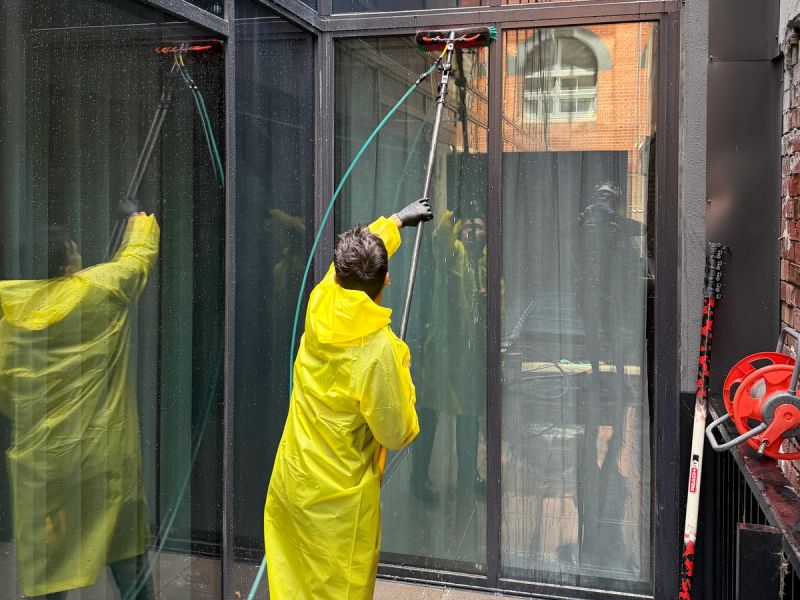
Office window cleaning and the hours nobody sees
Office window cleaning is judged by people who never watch it happen. The tenant on level three sees the glass on Monday morning and forms an opinion about the building from it, and nobody in that chain saw a technician.
That is why the hours are part of the quote rather than an afterthought. Glass on a main entrance gets done before the building fills, because a wet entrance at nine o'clock is a complaint even when the work is perfect.
It is also why the report matters more here than on a house. The person paying the invoice is usually a facilities manager or an owners corporation, and they have to show somebody else that the money bought something.
The other half of it is what the glass is doing to itself in between. Runoff from concrete and metal above the glazing carries alkali down the face of a building, and left on the glass it etches in permanently rather than washing off. That is the argument for a schedule over a phone call, and it is set out in full on high rise window cleaning.
Where we will send you somewhere else
Four things people ask before booking. Two of the answers send you to somebody else.
“We have a shopfront on a main street. Can you do it weekly?”
No, and not because it is beneath us. A weekly retail round works on density: twenty shops in one street, ten minutes each, one person on foot. We are set up for buildings that take half a day and need equipment on site, and our cost base would make your weekly clean absurd. A local window round will do it better and for a third of what we would have to charge.
“Can you do the inside on the same visit?”
Usually a separate visit, and it is worth understanding why. Interior glass needs access to occupied floors, keys or an escort, and none of the equipment that gets us to the outside. Booked together it is often the same day but two different pieces of work, and quoting it as one line hides that from you.
“Our building is four storeys. Do we need rope access?”
Almost certainly not, and you should be wary of a quote that says you do. A water-fed pole reaches about that height from the ground, needs nothing closed off and costs a fraction of a rope crew. Rope access earns its price above what a pole reaches, on buildings that give us somewhere to anchor. Height on its own does not decide it.
“Can you repair the seals and the cracked pane while you are there?”
No. Glazing is a licensed trade and we are a cleaning contractor. What you get instead is a written note and a photograph of everything we find, so the glazier arrives knowing what they are looking at rather than quoting a second inspection.
Reading a commercial window cleaning quote
Commercial quotes are hard to compare because the expensive part is invisible in all of them. Four questions make it visible, and all four are answerable before anyone attends.
- What access method is it priced on? Pole, lift or rope. If the quote does not say, it is priced on an assumption, and the assumption moves once somebody is standing in front of the building.
- Does it say what happens if the access has to change? The method is decided by what the building allows, and occasionally that is not settled until somebody is standing at the parapet. A quote that says who carries that is worth more than one that pretends the question cannot arise.
- Does it include the hours you actually need? Out-of-hours work is a real cost. A daytime price quoted for a building that can only be done at six in the morning is not a price for your building.
- What is the public liability cover, in dollars? Ask for the number and the certificate, not the word insured. Ours is $20 million and it goes out with the quote on request.
The cheapest commercial quote is usually the one that assumed a pole would reach. It is the most common reason a fixed price stops being fixed.
Questions facilities and strata managers ask
Do you clean street-level shopfronts?+
No. A weekly retail round is a different business built on density — many shops, a few minutes each, one person on foot. Our cost base is built around equipment and half-day jobs, so we would be the wrong and expensive answer. A local window round is the right one.
How high can you reach without a lift?+
A water-fed pole from the ground reaches roughly four storeys, which covers most office and warehouse glazing in Melbourne. Above that it depends on the building rather than on the height: where there is somewhere to anchor, the work goes onto ropes; where there is not, it goes onto a lift.
Do you work outside trading hours?+
Yes, and for entrances and food premises it is usually the sensible answer. It costs more per visit and often costs the building less overall, because nobody is being walked around wet glass at nine in the morning.
What paperwork do we get before the job?+
A Safe Work Method Statement written for your building, certificates of currency, induction cards for the attending crew, and a notice you can send to tenants under your own name. All of it before the booking is confirmed.
Is the inside of the glass included?+
Not in the same visit as a rule. Interior glass needs access to occupied floors and none of the outside equipment, so it is organised through the building and quoted as its own piece of work.
How often should a commercial building be done?+
More often than most are, and the reason is not appearance. Runoff from the materials above the glazing etches into glass if it is left to dry there, and that damage does not wash off. A building on a schedule never reaches that point.
Can you invoice the owners corporation rather than us?+
Yes. The scope is written so it reads the same to a tenant, a building manager and the committee paying it, which saves the argument about what was actually done.
Do you fix the windows as well?+
No. Cracked panes, failed seals and faulty hardware are a glazier's trade and a licensed one. We photograph what we find and write it up, so the right trade arrives knowing where to look.
About the expert

Ihor Sydorenko
Founder & Lead Rope Access Technician (IRATA Level 3) — WaterCrew Cleaning
Ihor has worked on ropes since 2013, starting on high-rise facades in Kyiv, where he founded and still runs the rope-access company Альпіністи Київ. He holds IRATA Level 3 — the highest grade in the international rope-access system, covering work supervision, safety planning and rescue.
- ✓ IRATA Level 3 rope access technician
- ✓ Working safely at heights
- ✓ Construction induction
- ✓ First aid