Gutter Cleaning Melbourne — Bolton Avenue, Hampton East
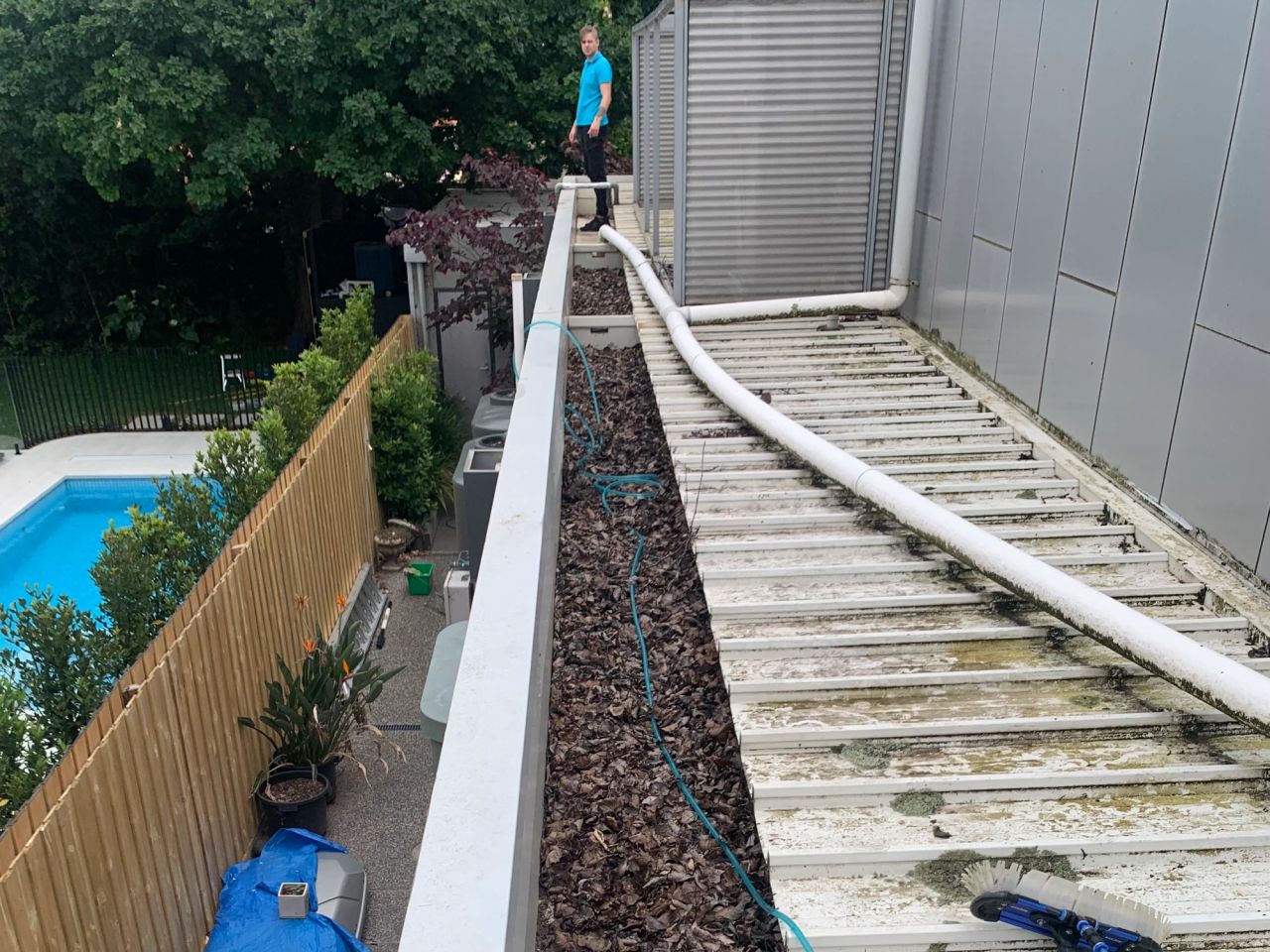
Gutter cleaning on a house with a flat Colorbond roof on Bolton Avenue, Hampton East, in late November. The gutters had not been cleared for years, and what was in them had long since stopped looking like leaf. Two technicians, four hours. A flat roof gives whatever lands on it nowhere to go, so the gutter ends up holding the lot.
- Location
- Hampton East 3188
- Completed
- 21 November 2023
- Crew
- 2 techs
The problem
A flat Colorbond roof does not shed leaf the way a pitched tile roof does. On a steep roof the wind takes a share of what lands and the rest slides off. On a flat sheet roof there is no slope to move anything, so what falls stays where it falls and works its way to the gutter line slowly, carried by water rather than by gravity. Add several years without a clean and the leaf stops behaving like leaf. It breaks down into a dense wet layer that holds its shape when you lift it, and at that point the gutter is carrying weight rather than water.
What we did
At that stage the work is removal, not flushing. Material in that condition does not move under a hose. Pushing water at it packs it tighter and sends the fine fraction into the downpipe, which is how a gutter that looks clear from the ladder blocks solid a metre below the outlet. So it came out by hand and by vacuum, along the full run rather than the stretches visible from the ground, and the downpipes were checked for flow afterwards rather than assumed to be clear. On a roof with no pitch the other half of the care is where weight goes. Sheet roofing spans between its fixings, and the line that carries a person is not always the line that looks solid, so the route across it is worked out before anyone steps on it.
- Full gutter run cleared by hand and vacuum rather than flushed
- Several years of broken-down leaf removed instead of redistributed
- Downpipe outlets cleared and flow checked afterwards
- Load kept over the supported line on flat sheet roofing
- Debris bagged and taken away rather than left on site
Result
- Two technicians, four hours
- Full run cleared and downpipes flowing
- Gutters carrying water again rather than weight
Nearby case studies
More projects in Hampton East
 Building washing
A seasonal wash on a two-storey weatherboard house on Villeroy Street, Hampton East, at the end of April. Roof, walls and glass in a single visit, in that order.
Read case study