Exterior Cleaning in Hampton East
About 950 houses here went up in the 1950s to a handful of plans, so the whole suburb reaches the same point at once. Insured crew, photos on every job.
- $20M public liability insurance
- Police-checked, WorkSafe compliant
- 5.0 from 170 Google reviews
- Not happy with the work? You don't pay
Hampton East has a name younger than most of its houses. Until 2000 this was Moorabbin West, renamed for how close it sits to Hampton, and it now holds a little over five thousand people on about one and a half square kilometres.
It is not Hampton, though, and the difference decides the work. Hampton is a beach suburb, and the job there is salt off the bay and sand the wind puts back on the glass. Hampton East sits inland behind the Nepean Highway and gets very little of either.
What it has instead is sameness. The part between Bluff Road and the Nepean Highway was a State Housing Commission estate of about 950 dwellings, built in the 1950s. One agency, one decade, a small number of standard plans, and a good share of it still standing as built.
That is unusual, and it changes how a house here gets judged. Not because these houses are in worse shape than anyone else's, but because there is nothing on the street different enough to measure them against.
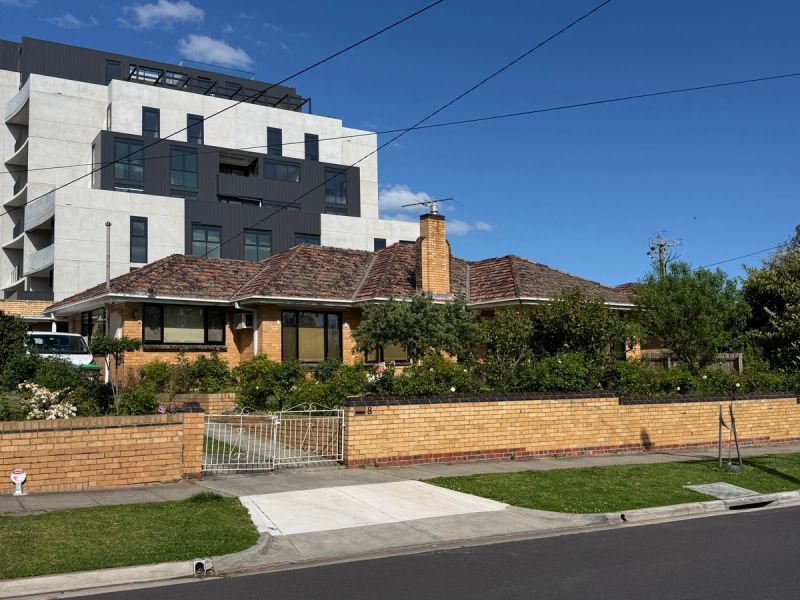
When every roof matches, none of them looks wrong
This is the stock the Commission left: brick to the eaves, concrete tile above it, and growth on the tile that has been there long enough to read as part of the roof.
Houses built to one plan in the same few years carry the same tile at the same pitch, under street trees planted the same season. They age together. So the growth on this roof sits at much the same stage as the growth on the roof next door, and the one after that.
That quietly breaks the test most owners actually use. People decide a roof needs attention when it starts to look worse than the neighbours'. On a street like this it never does, because every roof on it is doing the same thing on the same timetable. Sameness gets mistaken for a clean bill of health.
So we read it against the tile instead of against the street: whether the coating has gone, whether the growth is rooted in the surface or sitting on top of it, and whether the laps are still clear. Where it is rooted, the answer is a course of moss and lichen treatment rather than a wash. Where it is surface grime on sound tile, cleaning the tiles is the quicker and cheaper way out.
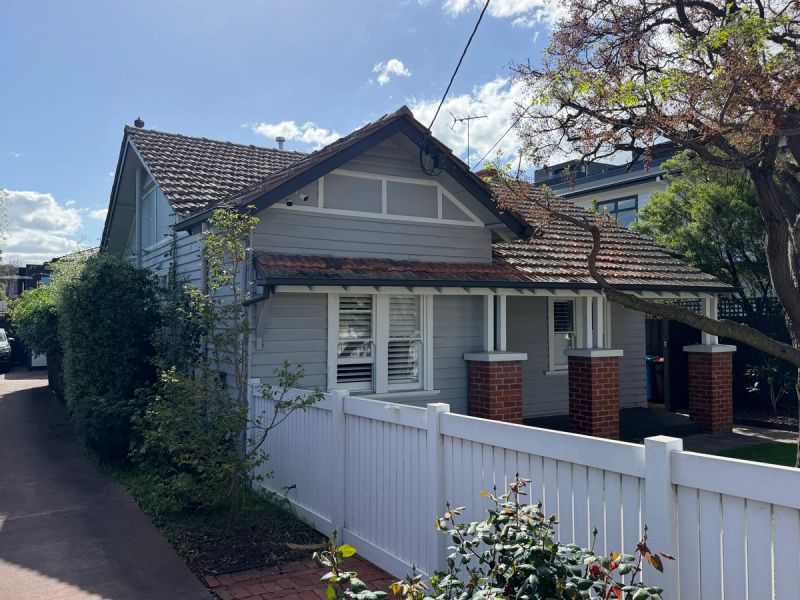
What a 1950s plan gives us to work with
The other half of the sameness is in our favour. These are single-storey houses with hip roofs and real eaves, on blocks with a driveway down one side and a fence you can reach over.
Almost everything on a house like this can be reached off the ground or off a ladder footed on level concrete. Nothing has to be worked from the street, nothing needs scaffold, and nobody has to ask a committee first.
It is the opposite of what is replacing the stock a few suburbs over. In Bentleigh the post-war houses come down for double-storey townhouses with shared walls and no side access, and those cost more to clean for exactly that reason.
Hampton East has seen less of that so far. It has since been named one of the state's activity centres, which is a planning label rather than anything built, so for now most of the suburb is still what the Commission put up. House washing and gutter cleaning here are about as straightforward as this work gets.
Services we run in Hampton East
Gutter cleaning
Vacuumed, downpipes flushed and flow-tested, photo report the same day.
See detailsSolar panel cleaning
Panels washed with demineralised water, frames included, output stops dropping off.
See detailsRoof cleaning
Terracotta and Colorbond, moss and lichen treated to slow regrowth.
See detailsWindow cleaning
Glass, frames and tracks, inside and out, streak-free on the dry check.
See detailsPressure cleaning
Driveways, paving and concrete brought back without scarring the surface.
See detailsSoft washing
Render, cladding and painted surfaces washed at low pressure.
See detailsJobs we've finished in Hampton East
 Building washing
A seasonal wash on a two-storey weatherboard house on Villeroy Street, Hampton East, at the end of April. Roof, walls and glass in a single visit, in that order.
Read case study Gutter cleaning
Gutter cleaning on a house with a flat Colorbond roof on Bolton Avenue, Hampton East, in late November. The gutters had not been cleared for years, and what was in them had long since stopped looking like leaf.
Read case studyWhat owners here ask before booking
Our whole street looks like this. Is it actually a problem?+
The street is not the benchmark, and on this one it cannot be. The houses went up together to the same plan, so the roofs reached this stage together. What decides it is the tile itself: whether the growth has roots in the surface or is sitting on it. That is a question you answer from a photograph up close, not from the footpath.
We are near Hampton. Do we get salt on the glass the way they do?+
Not to the same degree. Hampton East sits inland with the Nepean Highway between it and the bay, so the salt load and the wind-blown sand that drive the interval in the beach streets are much weaker here. Windows here go on an ordinary cycle rather than a coastal one.
It is an ex-Commission house. Does that change the method?+
Not because of who built it. What matters is the age of the surfaces, and they are what you would expect of the decade: a fired brick face doing the weatherproofing over mortar that will not take pressure, and concrete tile that turns porous once its coating has worn off. Both come clean with a solution and a low-pressure rinse rather than with force.
Can you get down the side of the house?+
Here, usually yes, and it is worth saying because it keeps the price down. A driveway down one side and a flat surface to foot a ladder on means the job runs off the ground. The same house with a neighbour's wall where that driveway is would cost more and take longer.
The roof has looked like that for years. Is it too late?+
Rarely too late, but years of growth change which option fits. Established lichen does not die on one exposure, so it comes off over a course of two or three applications a couple of months apart, and each application is its own visit. If what you need is for it to look right by a date instead, a soft wash is the honest answer and we will say so.
Rated by Melbourne
Hampton East jobs are posted to our Google profile with before-and-after photos as they finish.