Exterior Cleaning in South Melbourne
Emerald Hill brick, market verandahs and common property across the suburb. Insured crew, soft washing on 1880s render, photos every job.
- $20M public liability insurance
- Police-checked, WorkSafe compliant
- 5.0 from 170 Google reviews
- Not happy with the work? You don't pay
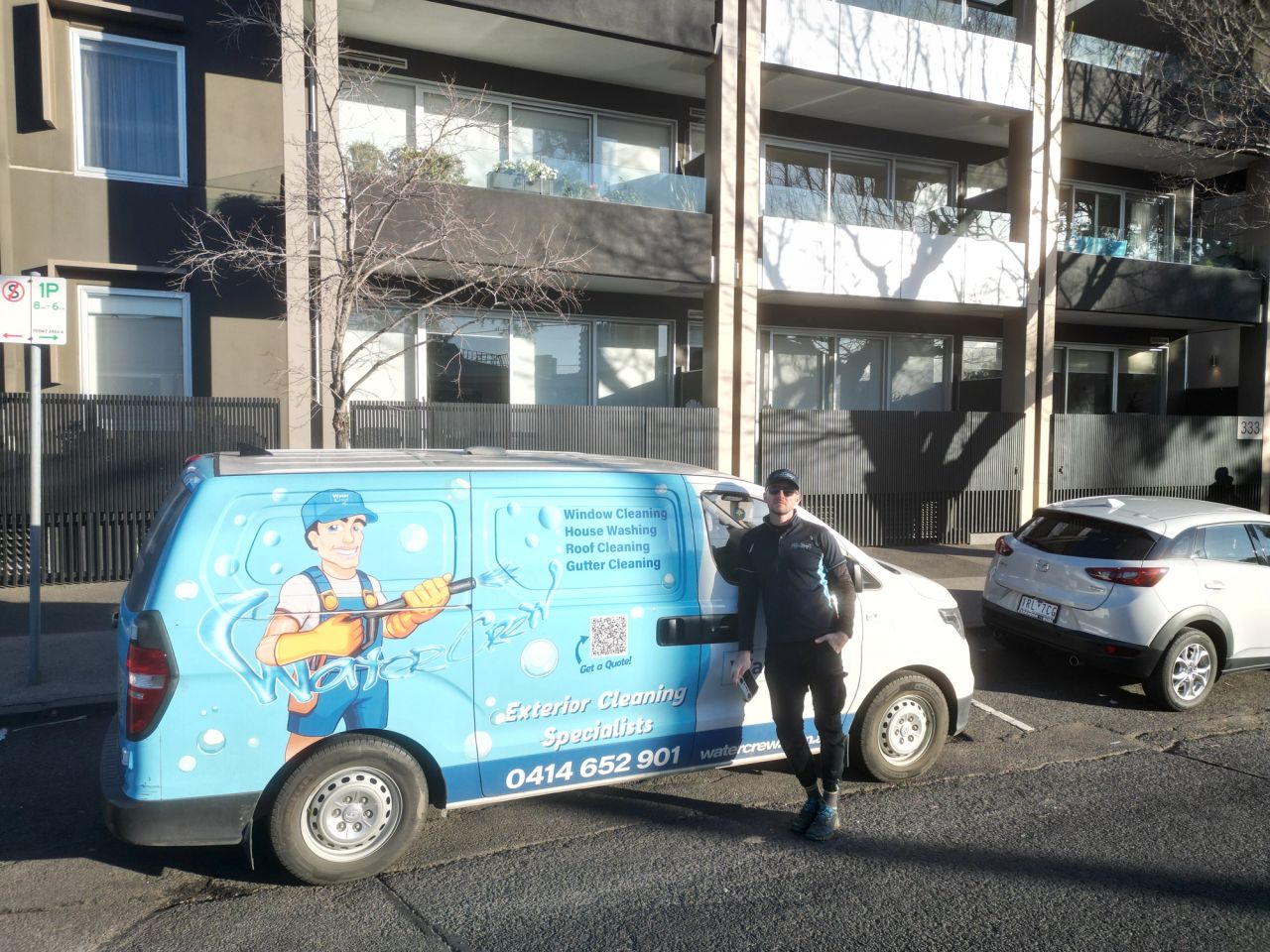
South Melbourne is dense, old and mostly rented. Under five per cent of dwellings are houses; the rest is flats and terraces, and more than half is tenanted. The work here is arranged by owners corporations, managing agents and the businesses along Clarendon Street rather than by someone standing in their own front garden.
It also holds more state-listed heritage than anywhere else we work. Emerald Hill and St Vincent Place are 1880s brick almost end to end, and the market at the middle of it has been trading since 1867.
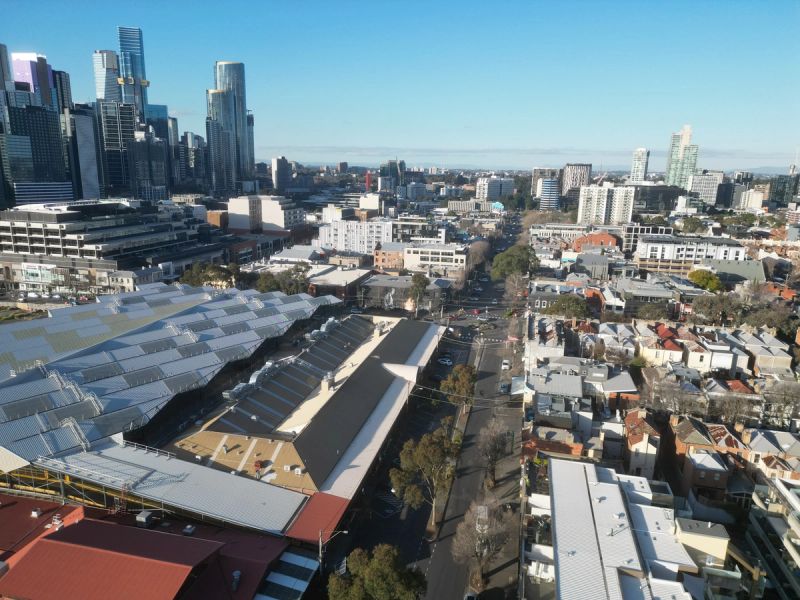
Eighteen-eighties brick with the towers behind it
From up here the whole argument of the suburb is in one frame. The market sits on its original ten acres between Coventry, Cecil and York Streets, the city stands immediately behind it, and everything in between stopped changing about a hundred and forty years ago.
What you are looking at is two of the most complete Victorian precincts in the state. Emerald Hill Estate was leased rather than sold, fifty years at a time, and that unusual arrangement produced an almost unbroken run of two-storey 1880s brick. St Vincent Place, laid out in 1868, is regarded as the finest nineteenth-century residential square in Australia.
The brick in all of it is laid in lime mortar, not cement. Lime is soft on purpose: it lets the wall move and lets moisture leave through the joint rather than through the brick face. Pressure takes it straight out, and once the joint is open the water goes into the wall instead of running off it.
Both precincts are on the Victorian Heritage Register, which makes any change to the surface a permit question rather than a decision. That is the strongest argument there is for cleaning as maintenance: done properly it puts nothing on the building and takes nothing off it.
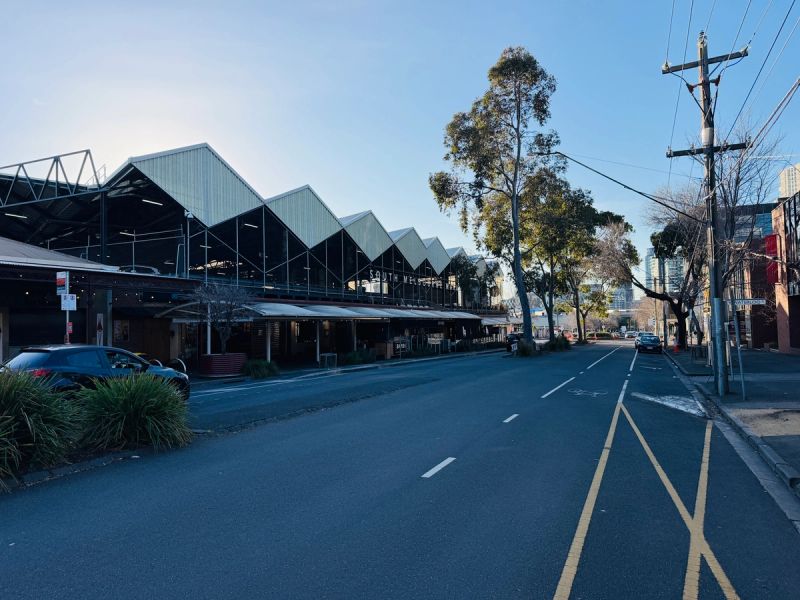
The verandahs take it from both sides
The entrance is the part everyone photographs and the part that takes the most punishment. Original Victorian fabric survives on the Coventry Street front, and the verandahs run continuously around Coventry, Cecil and York.
More than five million people come through here a year, and the verandahs take it from both directions. Underneath there is foot traffic and the grease that comes with food. Above, the roof and the fascia collect everything the street throws up at them.
Food soiling is not city dust. Grease and sugar films bond to paint and render, and water alone slides straight over them, which is why a frontage near the market can be washed and still look wrong the next morning.
And the thing carrying all of it is a heritage structure rather than shopfitting. The continuous verandahs are original fabric, so the method has to suit the building at the same time as it suits the mess, which rules out most of what would be quick.
Services we run in South Melbourne
The work we take on around South Melbourne. Each card opens the full service page.
Gutter cleaning
Vacuumed, downpipes flushed and flow-tested, photo report the same day.
See detailsSolar panel cleaning
Panels washed with demineralised water, frames included, output stops dropping off.
See detailsRoof cleaning
Terracotta and Colorbond, moss and lichen treated to slow regrowth.
See detailsWindow cleaning
Glass, frames and tracks, inside and out, streak-free on the dry check.
See detailsPressure cleaning
Driveways, paving and concrete brought back without scarring the surface.
See detailsSoft washing
Render, cladding and painted surfaces washed at low pressure.
See detailsJobs we've finished in South Melbourne
 Window cleaning
Three residential towers on Gladstone Street, South Melbourne, between twenty-two and twenty-five storeys, with all external glazing cleaned by rope access over three weeks by a crew of four.
Read case study Window cleaning
External window cleaning on an apartment block on Cobden Street, South Melbourne. The glass is spread across the building rather than gathered on one face, and a good deal of it can only be reached from inside the flats.
Read case studyQuestions we get from owners and agents
Do I need a permit to repaint the outside?+
In South Melbourne there's no single answer, which is unusual. External paint controls apply across most of the precincts here, but the Montague commercial precinct doesn't carry them at all. Two addresses a few streets apart can sit under opposite rules, so this one is worth checking by precinct rather than by suburb.
Why does the grease around the market come straight back?+
Because it isn't dust. Cooking residue and sugar bond to the surface and repel a plain water wash, so the front looks clean while the film is still there collecting the next layer. It needs a product that breaks the grease, not more pressure.
Can you work while the shops are trading?+
We'd rather not, and usually don't have to. Fronts along Clarendon Street and around the market get done before trade opens, which keeps equipment off the footpath at the busiest hours and means nobody is walking under the work.
The render went chalky after a previous wash. Can that be fixed?+
Not by cleaning it again. If the surface layer has been taken off, what's left is the raw material underneath, and only a coating or a render repair brings it back. That's the reason the method matters more than the frequency on buildings this old.
We manage a block here rather than own it. Does that change anything?+
Only the paperwork. We work to whatever reporting the agency or the committee needs, and common property gets scheduled the same way either side of that. Photos go out on the day, so there's something to attach to the file.
Nearby suburbs we cover
Rated by Melbourne
South Melbourne jobs are posted to our Google profile with before-and-after photos as they finish.