Exterior Cleaning in Albert Park
A terrace suburb where the whole front is a few square metres wide. Insured crew, soft washing on heritage render, photos on every job.
- $20M public liability insurance
- Police-checked, WorkSafe compliant
- 5.0 from 170 Google reviews
- Not happy with the work? You don't pay

Albert Park is a terrace suburb. Six in ten dwellings are terraces or semis, six in ten are lived in by the people who own them, and the median age is the highest of anywhere we work. That combination shows up in the questions we get: less about cost, more about whether the front will look wrong afterwards.
The other thing to know is that the suburb runs from the water inland. A house on Beaconsfield Parade and a house near Ferrars Street sit in the same postcode and in different corrosion conditions, and the servicing interval follows the distance, not the street directory.
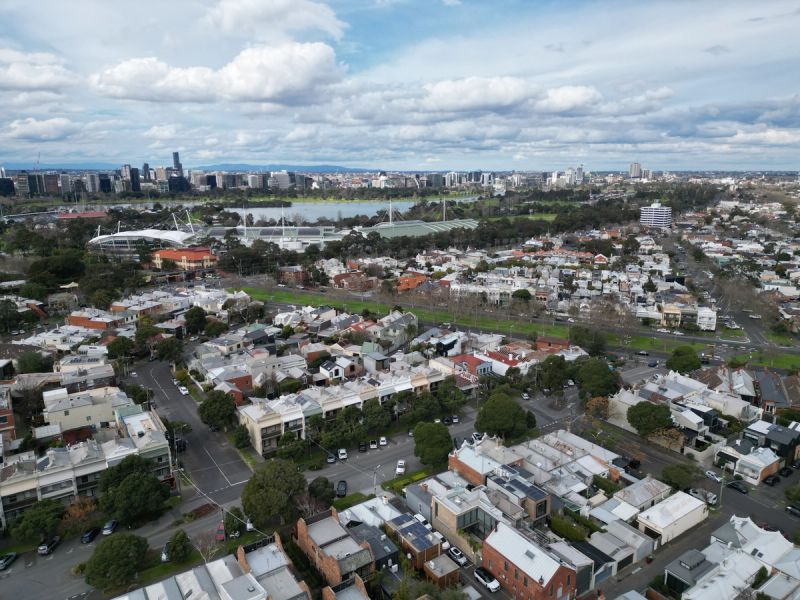
Rows of narrow roofs, then the lake
From up here the pattern is the roofs. Long runs of iron and terracotta pitched the same way, party walls between them, and almost no gaps. That is the practical fact behind most of the work: getting to a roof or a gutter usually means crossing a boundary or working off the front.
Nothing is far from anything either. The park and the lake sit at one end of the streets, the bay at the other, and what runs between them is short. A crew that starts near Kerferd Road can finish near Bridport Street without moving the van much, which is why work here gets scheduled by the block rather than by the address.
On a terrace the whole visual argument sits on a few square metres. The front is narrow, the decoration is concentrated on it, and there is nowhere for a mistake to hide — a patch cleaned unevenly on a twelve-metre frontage reads from across the road.
It cuts the other way too. On a row of matching fronts, a cleaned facade next to an uncleaned one is visible from the footpath. Work here tends to arrive in twos and threes.
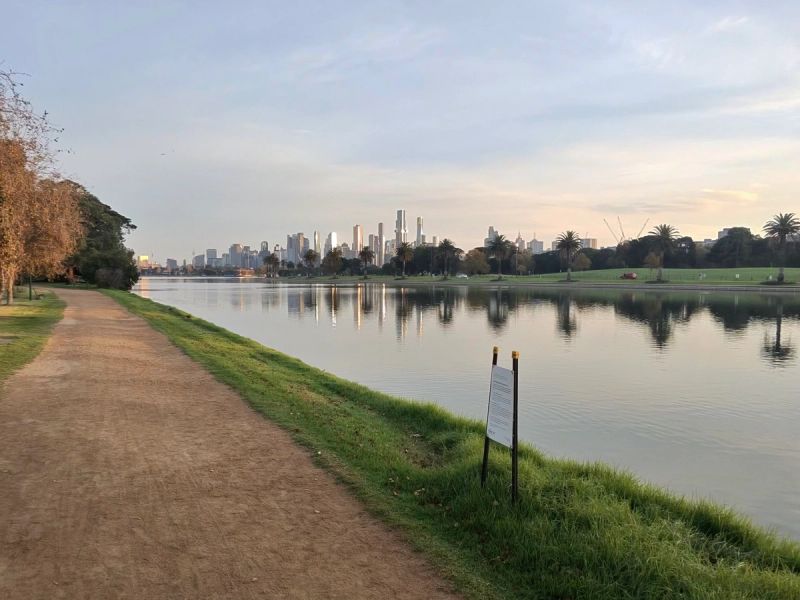
Fifty-one weeks a park, four days a circuit
The park is why the suburb has the shape it has. The lake sits at the end of the streets, the paths around it are busy by six in the morning, and for fifty-one weeks of the year that is all it is.
For four days in March it is a Grand Prix circuit. Attendance in 2026 was 483,934 across the event, and the track is built and taken down around a park that then goes back to being a park.
What the event leaves behind is finer than ordinary dust. Rubber and brake residue settles on sills, glazing and every horizontal surface near the perimeter, and it does not rinse away with the next rain the way street dust does.
So the sensible windows sit either side of it. Commercial fronts on Bridport Street and Victoria Avenue want doing before March, because that is when their year peaks. Residential frontages along the perimeter are worth a pass once the circuit comes down.
Services we run in Albert Park
The work we take on around Albert Park. Each card opens the full service page.
Gutter cleaning
Vacuumed, downpipes flushed and flow-tested, photo report the same day.
See detailsSolar panel cleaning
Panels washed with demineralised water, frames included, output stops dropping off.
See detailsRoof cleaning
Terracotta and Colorbond, moss and lichen treated to slow regrowth.
See detailsWindow cleaning
Glass, frames and tracks, inside and out, streak-free on the dry check.
See detailsPressure cleaning
Driveways, paving and concrete brought back without scarring the surface.
See detailsSoft washing
Render, cladding and painted surfaces washed at low pressure.
See detailsJobs we've finished in Albert Park
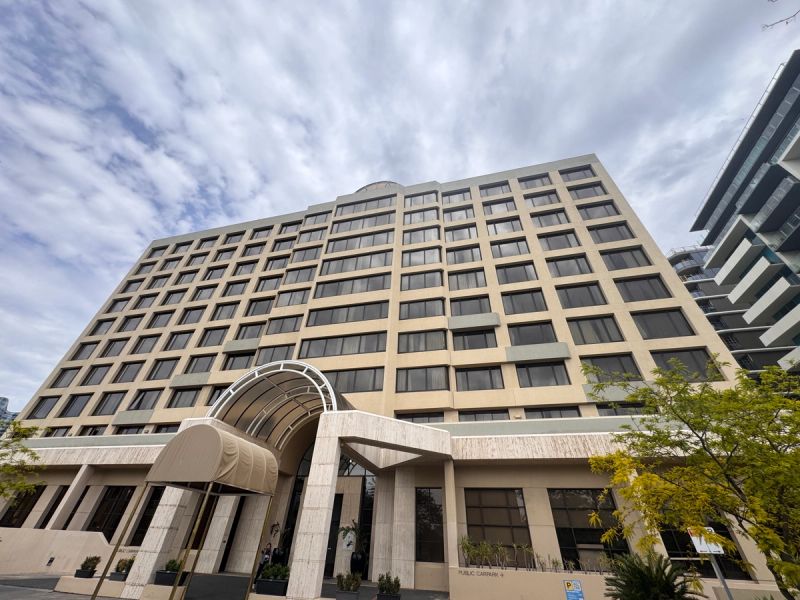 Window cleaning
High rise window cleaning at the View Hotel on Roy Street, Albert Park, carried out by rope access with a crew of three over four days.
Read case study Building washing
A house wash on Richardson Street, Albert Park, done to get the property ready for sale. Victorian facade at low pressure, the rear soft washed, windows and fly screens finished with it.
Read case study Window cleaning
An apartment window clean on Beaconsfield Parade, Albert Park, directly opposite the beach. The glass sits beyond the balcony line, so the outer faces had to be reached with specialist equipment rather than washed from the balcony.
Read case studyQuestions we get from owners here
Does the distance to the water really change things inside one suburb?+
It does. The standard for atmospheric corrosion puts the first 50 metres from a sheltered bay a full category above everything behind it, and Albert Park stretches from Beaconsfield Parade inland. Frames, railings and balcony fittings near the water need looking at more often than the same fittings four streets back.
Do I need a permit to repaint the outside?+
Very likely here. Almost every address in Albert Park falls inside a heritage precinct where external paint controls apply, so a change of colour is a planning question rather than a taste one. Cleaning doesn't touch the coating, which is why it's often the practical route on a rendered front.
My neighbour shares the wall. Does that change anything?+
It changes the access, not the method. We agree in advance where equipment stands and where run-off goes, because on a terrace row both of those cross a boundary. It's the part that causes arguments when nobody raises it first.
When should we book around the Grand Prix?+
Before it if the front is commercial, after it if it faces the perimeter. Trade on Bridport Street and Victoria Avenue peaks in March, so those fronts want to be right in February. Residential frontages are better done once the circuit is down and the residue has settled.
There's a tag on a heritage front. Can it just be taken off?+
Not with whatever removes it fastest. A solvent strong enough to lift paint off render will take the historic coating with the tag, and in a precinct with paint controls that turns a cleaning job into a planning problem. It's slower work and a different product on the wall.
Nearby suburbs we cover
Rated by Melbourne
Albert Park jobs are posted to our Google profile with before-and-after photos as they finish.