Exterior Cleaning in Brighton East
Inland of Hampton Street the salt eases off and the trees take over, while the highway edge works on everything facing it. Insured crew, photos on every job.
- $20M public liability insurance
- Police-checked, WorkSafe compliant
- 5.0 from 170 Google reviews
- Not happy with the work? You don't pay
Brighton East is the half of Brighton that does not face the water. Hampton Street is the line. West of it the bay sets the agenda; east of it the salt thins out and something else takes over.
What takes over is the canopy. The streets are wide, the verges are deep, and the tree cover that comes with Dendy Park, Hurlingham Park and Landcox Park does not stop at the park fence. Most roofs here sit under something.
Then there is the other edge. Nepean Highway runs along both the north-western and south-eastern boundaries, and a house facing it collects a different kind of dirt from one four streets in.
Two soiling sources on opposite sides of the same suburb, and they need different work. Which one you have is usually obvious from where the house sits, and it decides the interval as much as the method.
Low pitch, deep eaves, and water that will not leave
The housing here is largely interwar and Californian bungalow, and both were built with a shallower roof pitch than the Victorian and Edwardian stock closer to the bay. That shallow pitch is the thing that matters.
Water leaves a steep roof. On a low pitch it moves slowly, sits in the pan of each tile and dries where it stopped. Add the deep eaves those houses were designed with, and the gutter line spends most of the day in shade.
So the growth here is not a tidiness problem, it is a drainage one. Moss holds in the laps, the valleys silt up with leaf litter that broke down years ago, and the gutter ends up carrying soil rather than leaves.
It also changes the order of work. On a roof like this the valleys get cleared before anything else, because a treated roof draining into a blocked valley has solved nothing.
Terracotta on a bungalow of this age is usually the original tile, which rules out pressure and rules out walking the roof anywhere we can reach from the edge instead. Ninety-year-old clay cracks quietly and shows it a season later.
What the highway edge leaves on a wall
Two of this suburb's boundaries are Nepean Highway, north-west and south-east, and the houses along them and a few streets behind wear the traffic. It is the one thing here that has nothing to do with trees.
Traffic film is not leaf staining and it does not behave like it. Brake dust, tyre particulate and exhaust soot land as an even grey haze rather than in patches, they sit hardest on the side facing the road, and rain does not take them off — it just redistributes them.
On white weatherboard and light render it reads as the house looking tired rather than dirty, which is why people put up with it for years. On glass it shows first, and it is why the front windows of a highway-side house need doing more often than the back.
The practical answer is that these houses are rarely one job. The road-facing elevation runs on a shorter cycle than the rest of the house, and quoting both at the same interval overcharges one and underserves the other.
Four streets in from the highway none of this applies, and the canopy becomes the whole story again. That is why two houses in the same suburb can need opposite things done to them.
Services we run in Brighton East
Gutter cleaning
Vacuumed, downpipes flushed and flow-tested, photo report the same day.
See detailsSolar panel cleaning
Panels washed with demineralised water, frames included, output stops dropping off.
See detailsRoof cleaning
Terracotta and Colorbond, moss and lichen treated to slow regrowth.
See detailsWindow cleaning
Glass, frames and tracks, inside and out, streak-free on the dry check.
See detailsPressure cleaning
Driveways, paving and concrete brought back without scarring the surface.
See detailsSoft washing
Render, cladding and painted surfaces washed at low pressure.
See detailsJobs we've finished in Brighton East
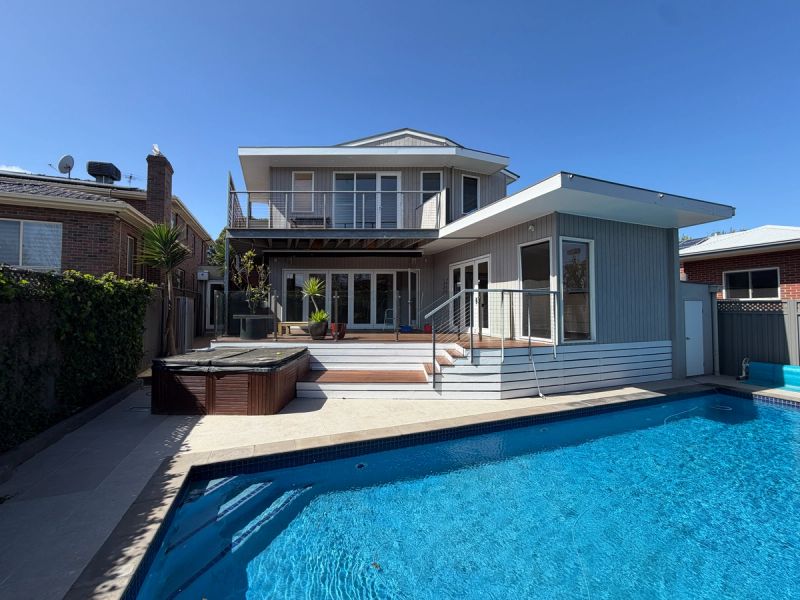 Window cleaning
A pre-sale window clean in Brighton East, with all glass done inside and out in a single five-hour visit.
Read case study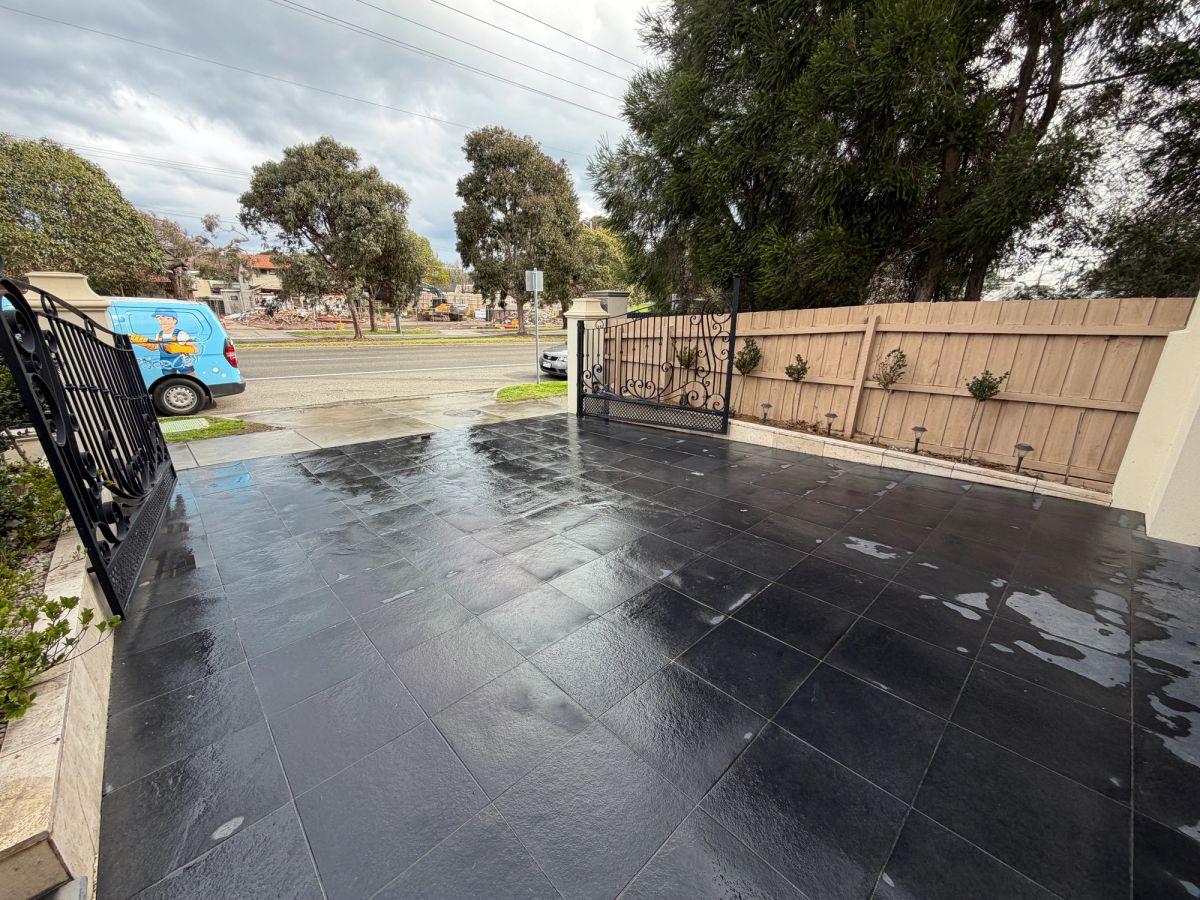
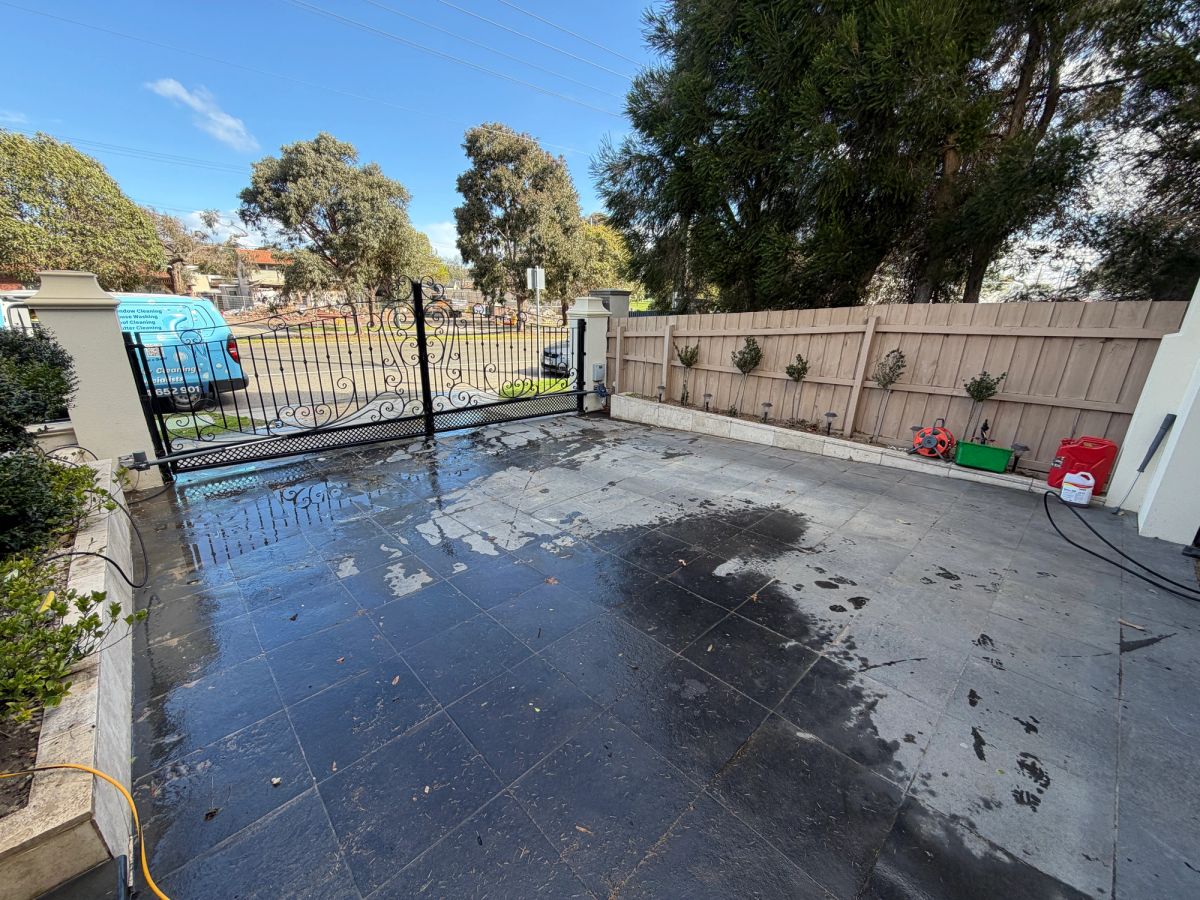
The driveway and paving at the same South Road house, done on the same day as the facade but recorded on its own because it is a different job on a different surface.
Read case study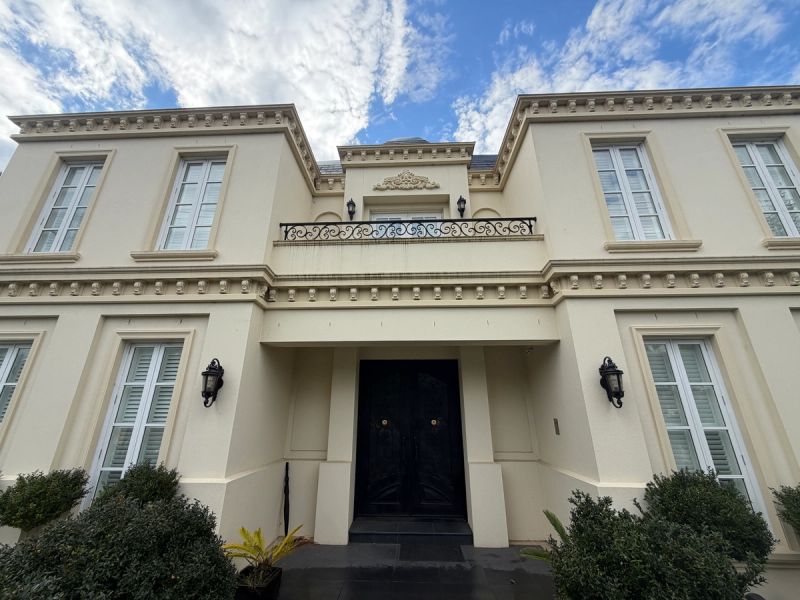 Building washing
A double-storey house on South Road, on the southern boundary of Brighton East, with around 800 square metres of beige render across its walls. The owner called about the facade rather than the roof: the house faces a main road, and the render had gone grey in a way that hosing it down had stopped fixing.
Read case study Building washing
A weatherboard house on Curzon Street. Painted timber walls, eaves lining, the outside faces of the gutters and the windows — the full outside of the house rather than one surface of it.
Read case study Window cleaning
A seasonal wash on Gleniffer Avenue: a large double-storey house, white render across the walls and around seventy floor-to-ceiling windows, which is an unusual amount of glass for a home rather than a building.
Read case studyWhat owners here ask before booking
Does Brighton East get the salt problem Brighton has?+
Less, but not none. You are a couple of kilometres from the water rather than on it, and the south-westerlies still carry salt inland. It shows up on the exposed elevation and on window frames rather than across the whole house, so it is a smaller job here than it is west of Hampton Street.
Why does the front of my house look dirtier than the back?+
If you are near Nepean Highway, that is road film rather than dirt. It lands evenly on whatever faces the traffic and rain does not remove it. The back of the same house can be genuinely clean while the front looks grey.
My roof is low-pitch terracotta. Is that a problem?+
It is the reason growth holds. Water moves slowly across a shallow pitch and dries in place instead of running off, so moss and lichen get the damp they need. It does not mean the roof is failing, it means the interval between cleans is shorter than on a steep roof.
Do you work the streets around Dendy Park?+
Yes, and those carry the heaviest leaf load in the suburb. A roof backing onto that much mature canopy fills its gutters faster than the same roof three streets away, which is worth knowing before you pick a schedule.
Can the roof and the gutters be done in one visit?+
They should be, and in that order. Everything that comes off a roof lands in the gutter, so clearing gutters first means clearing them twice. Booking them together also costs less than two separate visits.
Rated by Melbourne
Brighton East jobs are posted to our Google profile with before-and-after photos as they finish.