Exterior Cleaning in Camberwell
A suburb layered behind one shopping strip, where the wall that needs washing is usually the one facing a lane. Insured crew, photos on every job.
- $20M public liability insurance
- Police-checked, WorkSafe compliant
- 5.0 from 170 Google reviews
- Not happy with the work? You don't pay
Camberwell is close to twenty-two thousand people on about six square kilometres, and it is named after a pub. An inn went up at the Burke Road junction in 1853, the district took its name from it, and everything since has arranged itself around that corner.
The railway arrived in 1882, trams followed along Burke and Riversdale Roads in 1916, and the shopping strip filled in between the junction and the station from the 1880s onwards. The houses came in the same waves: Victorian and Edwardian close in around Prospect Hill Road, interwar further out, and two-storey infill and units on the big blocks since.
What makes Camberwell unusual to work in is not the strip. It is what sits behind it. From the 1960s the land behind the Burke Road shops was taken for car parking, and the result is a suburb stacked in depth: shopfronts, then service lanes and car parks, then houses immediately behind that.
So a great deal of wall in Camberwell faces a lane or a car park rather than a street. Nobody photographs those walls and nobody walks past them on purpose, which is exactly why they are the ones we get called to.
A building that cannot be opened
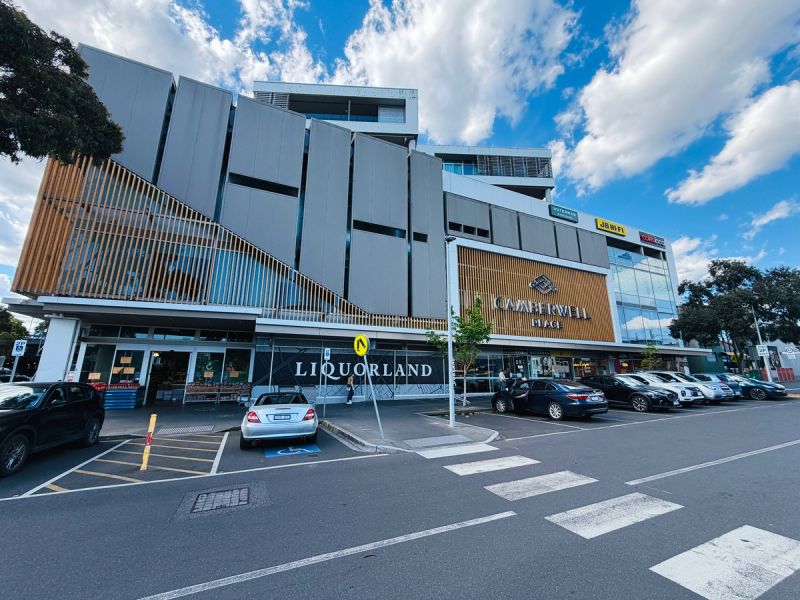
Camberwell Place is the one building here that works the other way. It opened on Burke Road in 2008 as The Well, the first fully enclosed shopping centre Camberwell had, and it got built only after VCAT overruled the council's objections to its height and density. Offices and a seven-level apartment tower went up with it. The name and the dining precinct came later.
Enclosed is the word that matters. A sealed, air-conditioned building has no window anybody can open, so every pane is cleaned from the outside, and there is no quiet face to work on because the shopfronts trade on one side and the car park runs underneath on the other.
That makes it an access job before it is a cleaning job. Reaching glass on a building like this comes down to what can be worked from the ground, what needs a pole, and what has to be reached from above. It is commercial window cleaning on the lower levels and high-rise window cleaning where the tower goes up, and both are quoted on reach and on what hours the work can run.
The apartments above it have the same problem in a smaller way. A resident on level five cannot clean the outside of their own glass, and the balcony balustrade is the surface that shows a Melbourne summer faster than anything else in the building.
The half of Camberwell that faces a car park
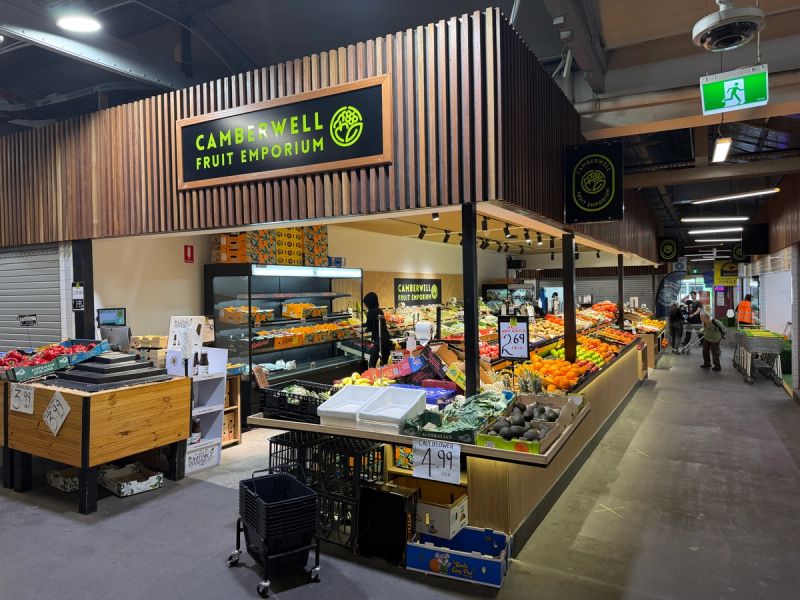
Camberwell Fresh Food Market stands on Riversdale Road, a couple of minutes' walk from the centre. Construction started in 1928 and the building was finished on 25 March 1929, on a site that had been a carriage factory since 1888. A refrigeration fault started a fire in April 1992 that burned down most of it, and the traders were back in by September.
It is a covered hall, and that is the distinction worth drawing, because covered is not the same as sealed. The centre up the road was built to shut the outside out completely. This one was built to keep the rain off, and in 2002 its rear wall was deliberately opened to the car park behind to make the way in easier.
So air, dust and traffic move straight through it every trading day, and what dirties a building like this is not weather but trade: deliveries from first light, trolleys over the same strip of concrete, bins, refrigeration, and the mess that comes with fruit, fish and flowers. That grime behaves differently from the weather kind. Weather sits on a surface and rinses off it, while trade grime gets walked into concrete and stays, so a loading area with years of it needs concrete cleaning rather than a hose. The walls above it are facade cleaning, at the same low pressure as anything else of that age.
And this is the part that matters for houses, because the same geometry runs right through the suburb. The wall facing a lane is the wall in shade, with the least air moving past it and the least reason for anyone to look at it. On a house that is usually the rear or the south elevation, and it is reliably the one that has gone green while the street frontage still looks fine. House washing in Camberwell is mostly about the sides nobody sees.
Services we run in Camberwell
The work we take on around Camberwell. Each card opens the full service page.
Gutter cleaning
Vacuumed, downpipes flushed and flow-tested, photo report the same day.
See detailsSolar panel cleaning
Panels washed with demineralised water, frames included, output stops dropping off.
See detailsRoof cleaning
Terracotta and Colorbond, moss and lichen treated to slow regrowth.
See detailsWindow cleaning
Glass, frames and tracks, inside and out, streak-free on the dry check.
See detailsPressure cleaning
Driveways, paving and concrete brought back without scarring the surface.
See detailsSoft washing
Render, cladding and painted surfaces washed at low pressure.
See detailsJobs we've finished in Camberwell
 Gutter cleaning
A two-storey house on Morey Street, Camberwell, with gutters full enough to be growing grass out of them. The whole run was cleared from the ground with SkyVac vacuum equipment, without anyone standing on the Colorbond.
Read case study Window cleaning
A Federation house on Royal Crescent, Camberwell, with its windows cleaned inside and out. Red brick to waist height and roughcast render above it, bay windows, carved timber brackets, a cross-braced balustrade and leadlight through the upper sashes.
Read case studyWhat owners here ask before booking
Our back wall is green but the front looks fine. Why?+
Because they are not getting the same weather. A rear or south wall facing a lane sits in shade for most of the day, dries slowly after rain and has very little air moving across it, and growth needs exactly those three things. The front of the same house gets sun and wind and stays clear for years longer. It is the same house and two different climates.
Can you get into a rear lane with equipment?+
Usually, and where we cannot, the work runs off hose lines from wherever the vehicle can sit legally. What we establish first is whether the lane is council land, shared access or part of a neighbouring title, because that decides where we are allowed to stand rather than where it would be convenient to stand.
We are in a heritage precinct near the Junction. Does that stop a wash?+
Cleaning is not an alteration, so generally no. Painting or rendering a frontage in an overlay usually is. We check what applies before quoting, and we do not make a call that belongs to the council or a heritage adviser. On old brick the method is a solution and a low-pressure rinse regardless of what the overlay says, because the brick decides that, not the planning scheme.
Who do we deal with for a shop, the landlord or us?+
Whoever is paying, but the scope gets written so it reads the same to a tenant, an agent and an owner. On a strip where the back of the building belongs to one party's lease and the front to another's, saying plainly which elevations are included saves the argument afterwards.
The apartment is on an upper level. Can the outside of the glass be done?+
Yes, and from outside, because the windows in buildings like these do not open far enough to be cleaned from within. How we reach it depends on the building: a pole from the ground on the lower levels, and rope access higher up. The owners corporation usually organises the whole elevation at once, which costs each apartment far less than doing them one at a time.
Rated by Melbourne
Camberwell jobs are posted to our Google profile with before-and-after photos as they finish.